For most of us buying a residential property is the largest financial investment of our lives. The last step in the buying process is signing the purchase documents at the notary’s office. As a result of constant changes in real estate law, the number of documents required to finalize your purchase as smoothly as possible are numerous. As your real estate notary, it is my duty to fully advise you what documents are required to complete your purchase, to review with you the purpose of each document, and advise you what your obligations are by signing.
1. GENERAL PURCHASING INFORMATION
The following is a summary of general purchase information and documentation:
A. The Contract of Purchase and Sale
Presumably, you have signed a Contract of Purchase and Sale, offering to buy a property from the seller for a certain price and with set completion, possession and adjustment dates subject to various conditions. Your offer, together with the seller’s acceptance, governs your purchase. The Offer to Purchase and the Acceptance (collectively, the Contract of Purchase and Sale) governs the rights and obligations of both yourself as the buyer and the registered owner as the seller. Changes to this document can only be made if you and the seller are in full agreement. Usually the Offer to Purchase is completed by the buyer with a qualified realtor and without the assistance of a notary. Patricia Wright will, however, be happy to review this contract with you and clarify any concerns that you may have.
B. Land Title Search
The office of Patricia D. Wright, Notary Public, will conduct a title search at the Land Title Office with regard to the property you are buying. Patricia D. Wright, Notary Public, will ensure that you are aware of all of the encumbrances/charges on the title to your property. The search will set forth:
the legal description of the property;
the name of the registered owner;
what encumbrances are registered against the title - both financial and non-financial
Some of these encumbrances (such as easements and rights of way) may remain on the title; some encumbrances (such as the seller’s mortgage) may not. The office of Patricia D. Wright will discuss these items with you. Should you be purchasing a strata unit, the office of Patricia D. Wright will also do a title search on the common property as you will become a common owner of this property as well and should be aware of any charges registered thereon.
C) Property Tax Search
The offices of Patricia D. Wright, Notary Public, will conduct a tax search at the local municipal or city tax office with regard to the property you are buying. The purpose of this search is to ensure that if there are any outstanding property taxes, they are paid up to date and you will not assume any of the seller’s taxes. This search will set forth:
what the current year’s taxes are;
whether the current year’s taxes are paid or not;
if the current year’s taxes are not paid, what the amount owing is.
The office of Patricia D. Wright, Notary Public, will review with you who is responsible for the current year’s taxes and why. In the City of Vancouver there are two tax billings each year, one in January - payable on or about February 2nd, and one in June - payable on or about July 1st. In most other cities and municipalities there is only one annual tax billing payable in the middle of the year and covering the taxes for the year from January 1st to December 31st. In some municipalities, owners may pay monthly payments towards the upcoming taxes and the offices of Patricia D. Wright, Notary Public, will need to be aware of this arrangement so as they can prepare any required adjustments between you and the purchaser or seller.
The tax search should also reflect if the City or Municipality has a separate utility billing for such items as water, sewer and garbage that the offices of Patricia D. Wright, Notary Public, will ensure are paid up to date and adjusted for accordingly.
D) SURVEY CERTIFICATE AND ZONING
Survey Certificate
Most mortgage companies require a Survey Certificate of the property to be secured before advancing the mortgage funds. The survey indicates that the house and any other permanent buildings (such as a garage), are located on the land you are purchasing and not encroaching on adjoining land. The survey report is certified by the surveyor who prepared the certificate. The survey that the seller may have, may not show all the improvements located on the property you are purchasing and may not be acceptable to your lender or to you. Patricia D. Wright strongly recommends that you consider obtaining a current Survey Certificate for your new property showing the current exact dimensions of the property and the location of all improvements.
Statutory Declaration
Most lenders will not accept any old survey or a survey that does not show the location of all the present buildings. Some lenders will accept a statutory declaration from the seller stating that they have compared the old survey to the present location of the buildings and that in their opinion the old survey is a correct representation. The office of Patricia D. Wright, Notary Public, will prepare this document, if required. If there is a garage on the property or additions to the house not shown on the survey or if the statutory declaration of the vendor regarding the existing survey is not acceptable to your lender, a new Survey Certificate must be obtained at your cost, before any mortgage funds will be advanced.
E) STRATA INFORMATION
Please note that we are currently awaiting new legislation in respect of the Condominium Act and the new Strata Property Act will take effect shortly - we will be updating our website accordingly.
Condominium Act By-Laws
Should your property be a condominium or strata complex, you should ensure that you have received and read the bylaws and financial statements of the strata corporation. You may wish to obtain a copy of the Condominium Act, which is the statute governing condominiums, and refer to it should you have any questions. Patricia D. Wright wishes to point out that there have been numerous amendments to this Act in the past and accordingly it may be necessary for you to check that no amendments have been made to a particular section. The Strata Corporation may, by by-law, limit the number of residential Strata Lots in a Strata Plan which may be rented out by the owners. Should it be your intention to rent out your property, I encourage you to check with the Strata Corporation to ensure you are able to do so. It is also imperative that you are aware of the parking stalls, storage lockers, etc. that come with the Condominium and whether these items are common property or limited common property.
Maintenance & Insurance
The office of Patricia D. Wright will contact the Property Management Company with regard to the common area maintenance of the property to determine the monthly levy and to ensure the account is current. It is also important to determine if any special levies have been passed or are being contemplated prior to purchasing your home. One of the duties of the Strata Corporation is to obtain and maintain insurance on the buildings, common property and any insurable improvements owned by the Strata Corporation to the full replacement value thereof. It is important, though, that you are aware that the occupants of the Strata Lot should have a tenants package fire insurance and public liability insurance coverage. The Strata Corporation no doubt, has a common liability insurance policy, the cost of which is included in your maintenance payments but it is up to each owner to insure his condominium and contents and to obtain any liability insurance for their unit.
Parking Stalls and Lockers
You should be aware of where your lockers and parking spaces are and ensure that they have been properly assigned to you. You should also determine whether they are common property or limited common property.
F) Conflict Form
Patricia D. Wright, Notary Public, may be acting for both you (on your purchase) and your lender (on the preparation of your mortgage documents). You must be made aware that if there is a dispute between you and your lender, that cannot be reconciled before the mortgage funds are advanced, Patricia D. Wright, Notary Public, will not be able to act for either party. In our experience such conflicts are rare. However, pursuant to the Rules of the Notary Society and in the interest of proper legal practice, you are required to be informed. In addition, as the office of Patricia D. Wright, Notary Public, is acting for both you and the lender, any relevant information we receive from you must be passed onto the lender and likewise any relevant information we receive from the lender must be passed onto you.
G) Non-Residency
Should the seller be a Non-Resident of Canada within the meaning of Section 116 of the Income Tax Act, Patricia D. Wright, Notary Public, will take the necessary steps to ensure that the required holdback of funds from the seller is obtained and not released until the necessary Non-Resident Clearance Certificate is obtained and delivered to our offices by the vendor’s notary or solicitor. The office of Patricia D. Wright, Notary Public, will ensure you are provided with the Purchaser's copy of the Non-Resident Income Tax Clearance Certificate issued by Revenue Canada for your records. In the event you are a Non-Resident of Canada, please ensure you have discussed the tax implications of your property disposition with your prior to the actual disposition. There is a significant holdback of monies from any Non-Resident Seller until such time as a Non-Resident Clearance Certificate is obtained from Revenue Canada, which, at present, takes several weeks.
H) Statement of Adjustments setting out Funds Required - Your Closing Costs
The Statement of Adjustments sets forth the total costs of your purchase. Patricia D. Wright, Notary Public, will itemize all costs for you so you will know exactly what you are paying for and why. The Statement of Adjustments required for your transaction will be prepared from information provided by provincial and municipal government offices, realtors, mortgage companies and others. Although believed to be correct, its accuracy cannot be guaranteed; if the figures received by our office are in error, further adjustments will be required between the seller and the buyer. Accordingly, the Statement of Adjustments should be read carefully to verify its accuracy. Errors and Omissions are excepted.
2. THE IMPORTANCE OF THE DATES OF YOUR CONTRACT
Avoid Fridays and month’s end
When you purchase a home, the completion, possession and adjustment dates are very important. Each date must be clearly spelled out in the offer and adhered to or the transaction may collapse. Time is of the essence with respect to your Contract of Purchase and Sale.
The most important date to both buyers and sellers is the closing date. This is the date when the monies change hands and title is transferred.
The possession and adjustment dates are usually the same and represent the dates you may take possession of the property and the dates for which all adjustments for the property are made to. The time of possession is normally 12:00 noon on the possession date.
It is always a good idea not to have your completion and possession dates the same as the seller will normally not allow the release of the keys until the seller has received the funds. The duties of Patricia Wright as your notary on the completion date, are many, including receiving and reviewing the seller’s documents from their solicitors, pre registration checks at the land title office, the filing of the documents at the appropriate land title office, reporting to the lenders to provide them with registration particulars, receiving mortgage funds at the offices of Patricia Wright as your notary, depositing the same into the trust account of Patricia Wright, preparing all the pay out reporting letters to the vendor’s notary or solicitor, realtors, lenders, etc. and prior to release of funds, a final post registration check at the land title office. As you can see, there a numerous steps to be done on the completion date. It may not always be possible to complete these prior to 12:00 noon and normally, completion would take place one day before possession.
Whenever possible, avoid closing the transaction on a Friday, the end of a month and before long weekends. Buyers who close then often face delays getting keys, and often a higher moving bill. Sellers discharging a mortgage can face additional interest payments to their lenders. If the funds reach the lender late after a Friday closing, three extra days interest is payable - four on a long weekend.
Whenever possible, steer clear of last days of the month when choosing a closing date. During peak times at the land title office there can be long delays in the actual filing of the documents and in receiving your mortgage funding from Lenders who may be funding many mortgages on the same date.
Finally, never have the completion date of the sale of your existing home and the completion date of the purchase of your new home on the same date. You would normally be dependant on your the funds from your sale to complete your purchase. Normally a contract provides that the purchaser of your home has until 12:00 midnight to deliver their monies to you as the seller. On the other hand, you as Purchaser of your new home, must have the required purchase funds in the office of Patricia D. Wright as your notary prior to 2:30 pm so that registration can be completed prior to the Land Title Office closing at 3:00 pm.
Waiver and Disclaimer
Please note that the information provided on this website is meant for general information purposes only and not as legal advice or notarial advice. This information on the site is provided to assist both our present and future clients. Each transaction and its surrounding circumstances are unique and each file handled by our firm is treated as such. Hopefully, you will find our website contains useful information that will assist you when you are planning to purchase a property or when you require a Mortgage, Will or other Notarial Service. By entering into our site, you fully release Patricia D. Wright, Notary Public, and her office of any and all liability that may arise from your use of the information contained therein. Again, this is not legal advice or notarial advice. You are further notified that any dissemination, distribution or copy of this site is strictly prohibited.
Friday, September 29, 2006


Recession stalking Central Canada (The article predicts interest rate cuts are on the way)
HEATHER SCOFFIELD
Globe and Mail Update
The Ontario economy has nearly stalled and, with the U.S. slowdown breathing down its neck, Canada's biggest province could possibly fall into recession, a new forecast from economists at Toronto-Dominion Bank warns.
“There is a chance of recession in Ontario. We have some numbers that are getting close to the line,” said Derek Burleton, co-author of the bank's latest provincial forecast.
A recession is typically defined as two successive quarters of economic contraction, and is frequently associated with rising levels of bankruptcy, company restructuring and job loss across many sectors.
The most likely scenario is that Ontario will grow by 1.8 per cent this year and 2.0 per cent next year, the TD forecast states. While those numbers are very low for a province that has traditionally carried the Canadian economy, they mask a steeper slowdown expected during the last half of this year and the first half of next year, Mr. Burleton said.
“It's going to be a difficult ride in the next few quarters.”
Ontario has already been struggling for a couple of years as a high Canadian dollar and rising energy costs have undermined its key manufacturing sector. However, the slowdown on the manufacturing side of the economy has largely been offset by a pickup on the services side, driven by strong consumers and a healthy job market.
But that delicate balance is being upset by the U.S. slowdown, which is only just beginning to be felt in Central Canada, he said. “Jobs will be the next shoe to drop.”
Auto production in southern Ontario will likely decline outright this year and next, the report says. The Canadian arms of Ford, General Motors and DaimlerChrysler are scaling back and a turnaround is not expected until 2008 when new production lines at Toyota, Honda and GM come on stream.
Quebec is in a similar bind. Tourism is suffering, the forest industry has been shedding jobs and the future looks dim for both those industries, the TD forecast argues, projecting 1.9 per cent growth this year and 1.8 per cent next year.
Neither province has much hope of a recovery to normal economic growth rates until 2008, TD says.
“For the manufacturing-based economies of Central Canada and some parts of the Atlantic [region] that have recently struggled under the weight of a high Canadian dollar and elevated energy prices, the dampening influence of weaker demand growth stateside has effectively quashed any hopes of a meaningful recovery until 2008.”
CIBC World Markets Inc. has a similar forecast for the Ontario economy, although it also expects the central bank to move decisively to revitalize Central Canada, economist Warren Lovely says. He projects that the Bank of Canada will cut interest rates four times in the next year, “not only to restrain the loonie, but also revive a badly sagging Central Canadian economy.”
He also sees manufacturing weakness spilling over into the broader economy — a repeat of the economic pain of the early 1990s.
Even the western provinces will feel a pinch from the global economic slowdown, economists say — although the divide between Alberta and the rest of the country will continue for a couple of years. “As the headwinds begin to blow from the south, the respectable overall growth trends in Canada are masking an increasingly skewed regional picture,” TD says.
“We not only concur that growth in the Alberta economy has passed its peak in the current cycle, but that the risks of a hard landing have been rising.”
The most probable scenario, however, is that the Alberta economy will be able to avoid the boom-bust cycle of the past, and coast gradually to growth rates of about 3 per cent a year, down from the 6.8 per cent expected this year. Prices for oil, gas and other commodities are sliding, the TD forecast says, and some capital spending plans will likely be delayed or cancelled.
“A softening in conditions in resource markets, including crude oil and forestry, will knock both Alberta and B.C. off their high growth horses over the next few years.”
CIBC, however, was far more upbeat about the prospects for the West, predicting that massive capital spending will continue, with commodities prices remaining high. Alberta's growth should continue to reach almost 7 per cent next year, Mr. Lovely forecasts.
Globe and Mail Update
The Ontario economy has nearly stalled and, with the U.S. slowdown breathing down its neck, Canada's biggest province could possibly fall into recession, a new forecast from economists at Toronto-Dominion Bank warns.
“There is a chance of recession in Ontario. We have some numbers that are getting close to the line,” said Derek Burleton, co-author of the bank's latest provincial forecast.
A recession is typically defined as two successive quarters of economic contraction, and is frequently associated with rising levels of bankruptcy, company restructuring and job loss across many sectors.
The most likely scenario is that Ontario will grow by 1.8 per cent this year and 2.0 per cent next year, the TD forecast states. While those numbers are very low for a province that has traditionally carried the Canadian economy, they mask a steeper slowdown expected during the last half of this year and the first half of next year, Mr. Burleton said.
“It's going to be a difficult ride in the next few quarters.”
Ontario has already been struggling for a couple of years as a high Canadian dollar and rising energy costs have undermined its key manufacturing sector. However, the slowdown on the manufacturing side of the economy has largely been offset by a pickup on the services side, driven by strong consumers and a healthy job market.
But that delicate balance is being upset by the U.S. slowdown, which is only just beginning to be felt in Central Canada, he said. “Jobs will be the next shoe to drop.”
Auto production in southern Ontario will likely decline outright this year and next, the report says. The Canadian arms of Ford, General Motors and DaimlerChrysler are scaling back and a turnaround is not expected until 2008 when new production lines at Toyota, Honda and GM come on stream.
Quebec is in a similar bind. Tourism is suffering, the forest industry has been shedding jobs and the future looks dim for both those industries, the TD forecast argues, projecting 1.9 per cent growth this year and 1.8 per cent next year.
Neither province has much hope of a recovery to normal economic growth rates until 2008, TD says.
“For the manufacturing-based economies of Central Canada and some parts of the Atlantic [region] that have recently struggled under the weight of a high Canadian dollar and elevated energy prices, the dampening influence of weaker demand growth stateside has effectively quashed any hopes of a meaningful recovery until 2008.”
CIBC World Markets Inc. has a similar forecast for the Ontario economy, although it also expects the central bank to move decisively to revitalize Central Canada, economist Warren Lovely says. He projects that the Bank of Canada will cut interest rates four times in the next year, “not only to restrain the loonie, but also revive a badly sagging Central Canadian economy.”
He also sees manufacturing weakness spilling over into the broader economy — a repeat of the economic pain of the early 1990s.
Even the western provinces will feel a pinch from the global economic slowdown, economists say — although the divide between Alberta and the rest of the country will continue for a couple of years. “As the headwinds begin to blow from the south, the respectable overall growth trends in Canada are masking an increasingly skewed regional picture,” TD says.
“We not only concur that growth in the Alberta economy has passed its peak in the current cycle, but that the risks of a hard landing have been rising.”
The most probable scenario, however, is that the Alberta economy will be able to avoid the boom-bust cycle of the past, and coast gradually to growth rates of about 3 per cent a year, down from the 6.8 per cent expected this year. Prices for oil, gas and other commodities are sliding, the TD forecast says, and some capital spending plans will likely be delayed or cancelled.
“A softening in conditions in resource markets, including crude oil and forestry, will knock both Alberta and B.C. off their high growth horses over the next few years.”
CIBC, however, was far more upbeat about the prospects for the West, predicting that massive capital spending will continue, with commodities prices remaining high. Alberta's growth should continue to reach almost 7 per cent next year, Mr. Lovely forecasts.
Monday, September 25, 2006
Further evidence of Canada's sound fiscal footing and the implication for Vancouver's property market
Hi All,
See the post below for some more evidence of Canada's good and improving fiscal situation in relation to the US.
If one is to look back to the high inflation and interest rate era from the 70's to the early 90's, our Federal Gov't was breaking a long tradition of peacetime fiscal austerity and ran huge deficits and incurred a huge debt. This caused an excess of demand for money thus driving up interest rates and inflation.
Debt reduction on the part of the Federal Gov't reduces demand pressure on Canada's debt market thus reducing the need for the Bank of Canada to raise interest rates. Reducing Gov't consumption and paying back deb is slightly deflationary and reduces pressure on the BOC to raise rates. By reducing debt we also reduce the cost of debt service which leaves more revenue or an opportunity for tax cuts which also reduces inflation.
Implications for Vancouver Real Estate
I see this as further evidence of a coming rate cut from the Bank of Canada. An upward valuation of the Chinese Yuan would be the only thing I see that could preclude this. An appreciation of the yuan would make the vast proliferation of cheap Chinese products we have to come to rely on very expensive very quickly, thus raising inflation across the rich world in a heartbeat.
We all know what a rate cut from the BOC will do for real estate here in Vancouver!
Looking forward to hearing what you think!
See the post below for some more evidence of Canada's good and improving fiscal situation in relation to the US.
If one is to look back to the high inflation and interest rate era from the 70's to the early 90's, our Federal Gov't was breaking a long tradition of peacetime fiscal austerity and ran huge deficits and incurred a huge debt. This caused an excess of demand for money thus driving up interest rates and inflation.
Debt reduction on the part of the Federal Gov't reduces demand pressure on Canada's debt market thus reducing the need for the Bank of Canada to raise interest rates. Reducing Gov't consumption and paying back deb is slightly deflationary and reduces pressure on the BOC to raise rates. By reducing debt we also reduce the cost of debt service which leaves more revenue or an opportunity for tax cuts which also reduces inflation.
Implications for Vancouver Real Estate
I see this as further evidence of a coming rate cut from the Bank of Canada. An upward valuation of the Chinese Yuan would be the only thing I see that could preclude this. An appreciation of the yuan would make the vast proliferation of cheap Chinese products we have to come to rely on very expensive very quickly, thus raising inflation across the rich world in a heartbeat.
We all know what a rate cut from the BOC will do for real estate here in Vancouver!
Looking forward to hearing what you think!
Tories to use $13.2-billion surplus to pay down debt
STEVEN CHASE
Globe and Mail Update
Ottawa — The federal government racked up a $13.2-billion surplus for last fiscal year and the Stephen Harper administration will apply all of it towards the national debt, The Globe and Mail has learned.
This is one of the largest,single debt repayments in Canadian history. It will help bring Canada's debt down to $481.5-billion.
Canada's federal debt has shrunk by $81.4-billion over the past decade, down from a peak of $562.9-billion in 1996-1997. The national debt as a percentage of the country's economic output is now at its lowest level in 24 years.
Finance Minister Jim Flaherty and Treasury Board President John Baird will reveal more this afternoon when they also announce $1-billion in cuts to government spending this year and next.
The savings will not yield new dollars for the Tories to spend because they've already been booked the savings in the 2006 budget to offset the cost of other Conservative measures.
The cutback exercise was announced in the May 2006 federal budget and Mr. Flaherty and Mr. Baird will update Canadians on their progress today.
Last week, Mr. Flaherty acknowledged some of the cuts will draw flak but said they're necessary to redirect dollars to more urgent priorities.
"Any time you reducing spending in an area or stop spending on particular programs, someone will be concerned," he said.
Globe and Mail Update
Ottawa — The federal government racked up a $13.2-billion surplus for last fiscal year and the Stephen Harper administration will apply all of it towards the national debt, The Globe and Mail has learned.
This is one of the largest,single debt repayments in Canadian history. It will help bring Canada's debt down to $481.5-billion.
Canada's federal debt has shrunk by $81.4-billion over the past decade, down from a peak of $562.9-billion in 1996-1997. The national debt as a percentage of the country's economic output is now at its lowest level in 24 years.
Finance Minister Jim Flaherty and Treasury Board President John Baird will reveal more this afternoon when they also announce $1-billion in cuts to government spending this year and next.
The savings will not yield new dollars for the Tories to spend because they've already been booked the savings in the 2006 budget to offset the cost of other Conservative measures.
The cutback exercise was announced in the May 2006 federal budget and Mr. Flaherty and Mr. Baird will update Canadians on their progress today.
Last week, Mr. Flaherty acknowledged some of the cuts will draw flak but said they're necessary to redirect dollars to more urgent priorities.
"Any time you reducing spending in an area or stop spending on particular programs, someone will be concerned," he said.
Thursday, September 21, 2006
Vancouver real estate- Do you know what the market is doing?
When it comes to marketing and branding I always say the most important thing for any professional to do is to be seen as an expert in your field. We are in the information age, and consumers more now than ever are sponges for information. The real estate market is a great example of this. Over the past few years we have seen the market explode with houses selling the same day they are listed and we have also seen an explosion of real estate agents enter the market.
With the age of information also comes the age of confusion. The problem many consumers face now is what is credible information and who can we trust? I always tell the real estate professionals I work with the more useful information you can have associated with your name the easier it will be to separate yourself from the crowd.
It really is hard these days to go somewhere and not see the face of a real estate agent. We see advertising on buses, billboards, park benches, magazine and the list goes on. The challenge with these methods is they do not provide the consumer with what they are really after, information.
I was recently introduced to a piece of technology which does just that. A friend of mine Mike Stewart, who is a realtor in downtown Vancouver, has a great little tool on his website everyone who is looking for real estate should be using. It is a real estate tracker in real time letting you know what is available through all sources. One of the most impressive features of this is it has the information BEFORE MLS does; allowing the consumer to be up to date at all times.
Another useful benefit of this tool is you can monitor what houses are selling for. So why is this important to you? Let’s say you are looking to sell your house sometime in the next year but you are just waiting for the right time. This will allow you to monitor the houses in your neighbourhood and see what they are selling for thus giving you a great feel for what the market is doing.
In our world cluttered with advertising and marketing messages the only way to stand out is to make life easier for people. I think Mike is doing a fine job of standing out and allowing people to get the information they want and need at their own pace and on their own terms. Whether you are buying or selling you will definitely want to check this one out.
Cheers,
Chuck Brady
chuck@chuckbrady.ca
604-720-7563
With the age of information also comes the age of confusion. The problem many consumers face now is what is credible information and who can we trust? I always tell the real estate professionals I work with the more useful information you can have associated with your name the easier it will be to separate yourself from the crowd.
It really is hard these days to go somewhere and not see the face of a real estate agent. We see advertising on buses, billboards, park benches, magazine and the list goes on. The challenge with these methods is they do not provide the consumer with what they are really after, information.
I was recently introduced to a piece of technology which does just that. A friend of mine Mike Stewart, who is a realtor in downtown Vancouver, has a great little tool on his website everyone who is looking for real estate should be using. It is a real estate tracker in real time letting you know what is available through all sources. One of the most impressive features of this is it has the information BEFORE MLS does; allowing the consumer to be up to date at all times.
Another useful benefit of this tool is you can monitor what houses are selling for. So why is this important to you? Let’s say you are looking to sell your house sometime in the next year but you are just waiting for the right time. This will allow you to monitor the houses in your neighbourhood and see what they are selling for thus giving you a great feel for what the market is doing.
In our world cluttered with advertising and marketing messages the only way to stand out is to make life easier for people. I think Mike is doing a fine job of standing out and allowing people to get the information they want and need at their own pace and on their own terms. Whether you are buying or selling you will definitely want to check this one out.
Cheers,
Chuck Brady
chuck@chuckbrady.ca
604-720-7563
Wednesday, September 20, 2006
Fed stands pat on rates
Associated Press
WASHINGTON — The Federal Reserve left a key interest rate unchanged on Wednesday as falling energy prices helped to restrain inflation pressures.
Federal Reserve Chairman Ben Bernanke and his colleagues issued a brief announcement saying they would leave the federal funds rate, the interest that banks charge each other, at 5.25 per cent.
The decision represents a break for borrowers. It means that banks' prime lending rate, the benchmark for millions of consumer and business loans, will remain at 8.25 per cent.
The Fed also had left rates unchanged at their last meeting in August, breaking a record string of 17 rates hikes that had driven the funds rate to its highest level in more than five years.
The decision to leave rates alone for a second time had been widely expected in financial markets, given recent favorable developments on inflation. Oil prices have fallen by more than 20 per cent over the past two months and a cooling housing market has contributed to a slowdown in overall growth.
WASHINGTON — The Federal Reserve left a key interest rate unchanged on Wednesday as falling energy prices helped to restrain inflation pressures.
Federal Reserve Chairman Ben Bernanke and his colleagues issued a brief announcement saying they would leave the federal funds rate, the interest that banks charge each other, at 5.25 per cent.
The decision represents a break for borrowers. It means that banks' prime lending rate, the benchmark for millions of consumer and business loans, will remain at 8.25 per cent.
The Fed also had left rates unchanged at their last meeting in August, breaking a record string of 17 rates hikes that had driven the funds rate to its highest level in more than five years.
The decision to leave rates alone for a second time had been widely expected in financial markets, given recent favorable developments on inflation. Oil prices have fallen by more than 20 per cent over the past two months and a cooling housing market has contributed to a slowdown in overall growth.
Tuesday, September 19, 2006
Inflation rate eases
TAVIA GRANT
Globe and Mail Update
Canada's inflation rate eased to a 2.1-per-cent annual rate in August as gasoline-price increases slowed, confirming expectations that interest rates are unlikely to budge for the rest of the year.
It's the third month in a row that the rate dropped, marking the longest such stretch in two years, Statistics Canada said Tuesday. The consumer price index eased after rising at a 2.4-per-cent pace in July.
The report, which came in largely as expected, confirmed expectations that the Bank of Canada won't move on the interest-rate front this year, economists said. The central bank has held its key lending at 4.25 per cent in both of its last two decisions on expectations a weaker U.S. economy will moderate domestic growth.
“With the economy operating right at potential, core inflation right on target, and interest rates at neutral, it's going to take a major surprise to push the (central) bank off the sidelines at this point,” said Douglas Porter, deputy chief economist at BMO Nesbitt Burns in a note.
Related to this article
Tuesday's inflation numbers confirmed that the Canadian economy is divided along regional lines. Alberta's inflation rate hit a three-year high of 4.7 per cent in August, more than double the national average, from a 4.3-per-cent pace in July.
“Understanding Canadian inflation, it increasingly seems, requires merely looking at where you live,” said Warren Lovely, an economist at CIBC World Markets Inc., in a report. “Are you making a living in Alberta, where it's difficult to exaggerate the speed with which home prices are rising, or are you settled in Central Canada, where price gains are more controlled?”
Homeowners' replacement costs, for example, soared 43.4 per cent in Alberta in August. By contrast, the sub-index, which measures the worn-out structural portion of housing and is estimated using new housing prices, was up around 4 per cent in other large provinces such as Ontario, Quebec and British Columbia.
Homeowners' replacement cost index, rose 8.1 per cent in August from a year ago and has risen every month since December. This sub-index accounts for a large share of the total consumer price index basket and is one factor pushing Canada's inflation rate higher.
National gasoline prices were 9 per cent higher this August than last year, a more modest increase after a 16.1-per-cent increase between July of this year and last year.
Other prices that rose included mortgage interest costs and electricity prices.
The range of replacement costs varied substantially from province to province. “By all counts, Alberta's housing sector stands out clearly from that of the other provinces,” Statscan said. “The boom in the oil sector, combined with a high employment rate and a high degree of consumers' confidence, translated into a surge in demand for new houses in that province.”
Mortgage interest costs swelled as the value of new properties increased and interest rates rose.
Electricity prices also climbed as Ontario, Alberta, Quebec and British Columbia saw price hikes.
Those price increases were offset by lower prices for computer equipment and supplies, women's clothing, video equipment and natural gas, Statscan said.
The index for computer equipment and supplies has plunged 18 per cent from a year ago, while video equipment is down 11.6 per cent.
“Although consumers only occasionally purchase these products, they exert an important influence in reducing upward price pressures,” the report said.
Stripping out the effect of the cut in the goods and services tax, overall inflation would have been up 2.6 per cent in August, a slower rate than the 2.9 per cent pace in July, according to Ted Carmichael, chief economist at J.P. Morgan Securities Canada Inc.
The core rate, which excludes the eight most volatile items in the index, was unchanged at 1.5 per cent. This index, closely watched by the central bank as a sign of underlying price changes, has remained stable over the past year, Statscan said.
On a monthly basis, prices paid by consumers rose 0.2 per cent in August, “largely as a result of pressures from the housing sector,” the report said.
Analysts polled by Bloomberg News had expected a 2.1-per-cent annual rate and a core rate of 1.5 per cent.
The Bank of Canada makes its next interest-rate decision on Oct. 17.
The Canadian dollar traded at 89.19 cents (U.S.) after the report, down from yesterday's close of 89.45 cents.
Globe and Mail Update
Canada's inflation rate eased to a 2.1-per-cent annual rate in August as gasoline-price increases slowed, confirming expectations that interest rates are unlikely to budge for the rest of the year.
It's the third month in a row that the rate dropped, marking the longest such stretch in two years, Statistics Canada said Tuesday. The consumer price index eased after rising at a 2.4-per-cent pace in July.
The report, which came in largely as expected, confirmed expectations that the Bank of Canada won't move on the interest-rate front this year, economists said. The central bank has held its key lending at 4.25 per cent in both of its last two decisions on expectations a weaker U.S. economy will moderate domestic growth.
“With the economy operating right at potential, core inflation right on target, and interest rates at neutral, it's going to take a major surprise to push the (central) bank off the sidelines at this point,” said Douglas Porter, deputy chief economist at BMO Nesbitt Burns in a note.
Related to this article
Tuesday's inflation numbers confirmed that the Canadian economy is divided along regional lines. Alberta's inflation rate hit a three-year high of 4.7 per cent in August, more than double the national average, from a 4.3-per-cent pace in July.
“Understanding Canadian inflation, it increasingly seems, requires merely looking at where you live,” said Warren Lovely, an economist at CIBC World Markets Inc., in a report. “Are you making a living in Alberta, where it's difficult to exaggerate the speed with which home prices are rising, or are you settled in Central Canada, where price gains are more controlled?”
Homeowners' replacement costs, for example, soared 43.4 per cent in Alberta in August. By contrast, the sub-index, which measures the worn-out structural portion of housing and is estimated using new housing prices, was up around 4 per cent in other large provinces such as Ontario, Quebec and British Columbia.
Homeowners' replacement cost index, rose 8.1 per cent in August from a year ago and has risen every month since December. This sub-index accounts for a large share of the total consumer price index basket and is one factor pushing Canada's inflation rate higher.
National gasoline prices were 9 per cent higher this August than last year, a more modest increase after a 16.1-per-cent increase between July of this year and last year.
Other prices that rose included mortgage interest costs and electricity prices.
The range of replacement costs varied substantially from province to province. “By all counts, Alberta's housing sector stands out clearly from that of the other provinces,” Statscan said. “The boom in the oil sector, combined with a high employment rate and a high degree of consumers' confidence, translated into a surge in demand for new houses in that province.”
Mortgage interest costs swelled as the value of new properties increased and interest rates rose.
Electricity prices also climbed as Ontario, Alberta, Quebec and British Columbia saw price hikes.
Those price increases were offset by lower prices for computer equipment and supplies, women's clothing, video equipment and natural gas, Statscan said.
The index for computer equipment and supplies has plunged 18 per cent from a year ago, while video equipment is down 11.6 per cent.
“Although consumers only occasionally purchase these products, they exert an important influence in reducing upward price pressures,” the report said.
Stripping out the effect of the cut in the goods and services tax, overall inflation would have been up 2.6 per cent in August, a slower rate than the 2.9 per cent pace in July, according to Ted Carmichael, chief economist at J.P. Morgan Securities Canada Inc.
The core rate, which excludes the eight most volatile items in the index, was unchanged at 1.5 per cent. This index, closely watched by the central bank as a sign of underlying price changes, has remained stable over the past year, Statscan said.
On a monthly basis, prices paid by consumers rose 0.2 per cent in August, “largely as a result of pressures from the housing sector,” the report said.
Analysts polled by Bloomberg News had expected a 2.1-per-cent annual rate and a core rate of 1.5 per cent.
The Bank of Canada makes its next interest-rate decision on Oct. 17.
The Canadian dollar traded at 89.19 cents (U.S.) after the report, down from yesterday's close of 89.45 cents.
Thursday, September 14, 2006
Home prices could rise for decades
Bubble — what bubble?
Canadian home prices, already on a tear for years, are expected to grow on average almost 4 per cent a year over the next decade and a half, a Toronto-Dominion Bank report said Thursday.
The pace of growth will fluctuate from region to region. On the whole, however, prices are seen rising as more people choose to own homes, wages climb and unemployment remains low. Canadian house prices are already 10.8 per cent higher than last year, according to Statistics Canada.
“The combination of weaker demographic demand for housing is likely to be offset by rising home ownership rates, rising personal income, a modestly lower long-term rate of unemployment and more modest construction of new homes,” wrote the report's author, chief economist Craig Alexander.
House prices in Alberta will continue to streak upwards, albeit at a slower pace than in recent years, the bank said.
“All of the stars are aligned for Calgary and Edmonton to experience above-average price growth in the future,” said Mr. Alexander.
“However, it should be stressed that the recent pace of price gains in these markets have been completely unsustainable and will eventually come back to earth when the housing markets become more balanced.”
In Calgary, house prices were a whopping 56 per cent higher this July from last July, while in Edmonton, they've rocketed by almost a third in the past year.
Canadian home prices, already on a tear for years, are expected to grow on average almost 4 per cent a year over the next decade and a half, a Toronto-Dominion Bank report said Thursday.
The pace of growth will fluctuate from region to region. On the whole, however, prices are seen rising as more people choose to own homes, wages climb and unemployment remains low. Canadian house prices are already 10.8 per cent higher than last year, according to Statistics Canada.
“The combination of weaker demographic demand for housing is likely to be offset by rising home ownership rates, rising personal income, a modestly lower long-term rate of unemployment and more modest construction of new homes,” wrote the report's author, chief economist Craig Alexander.
House prices in Alberta will continue to streak upwards, albeit at a slower pace than in recent years, the bank said.
“All of the stars are aligned for Calgary and Edmonton to experience above-average price growth in the future,” said Mr. Alexander.
“However, it should be stressed that the recent pace of price gains in these markets have been completely unsustainable and will eventually come back to earth when the housing markets become more balanced.”
In Calgary, house prices were a whopping 56 per cent higher this July from last July, while in Edmonton, they've rocketed by almost a third in the past year.
Tuesday, September 12, 2006
The global housing market Checking the thermostat

Sep 7th 2006
From The Economist print edition
Property prices are cooling fast in America, but heating up elsewhere
HOUSES are not just places to live in; they are increasingly important to whole economies, which is why The Economist started publishing global house-price indicators in 2002. This has allowed us to track the biggest global property-price boom in history. The latest gloomy news from America may suggest that the world is on the brink of its biggest ever house-price bust. However, our latest quarterly update suggests that, outside America, prices are perking up. (Note how little Canada has gone up compared to the US, UK, and Australia)
America's housing market has certainly caught a chill. According to the Office of Federal Housing Enterprise Oversight (OFHEO), the average price of a house rose by only 1.2% in the second quarter, the smallest gain since 1999. The past year has seen the sharpest slowdown in the rate of growth since the series started in 1975. Even so, average prices are still up by 10.1% on a year ago. This is much stronger than the series published by the National Association of Realtors (NAR), which showed a rise of only 0.9% in the year to July.
The OFHEO index is thought to be more reliable because it tracks price changes in successive sales of the same houses, and so unlike the NAR series is not distorted by a shift in the mix of sales to cheaper homes. The snag is that the data take time to appear. Prices for this quarter, which will not be published until December, may well be much weaker. A record level of unsold homes is also likely to weigh prices down. The housing futures contract traded on the Chicago Mercantile Exchange is predicting a fall of 5% next year.
Elsewhere, our global house-price indicators signal a cheerier story. House-price inflation is faster than a year ago in roughly half of the 20 countries we track (see table). Apart from America, only Spain, Hong Kong and South Africa have seen big slowdowns. In ten of the countries, prices are rising at double-digit rates, compared with only seven countries last year.
European housing markets—notably Denmark, Belgium, Ireland, France and Sweden—now dominate the top of the league. Anecdotal evidence suggests that even the German market is starting to wake up after more than a decade of flat or falling prices, but this has yet to show up the index that we use, which is published with a long lag (there are no figures for 2006). If any readers know of a more timely index, please let us know.
Some economists have suggested that Britain and Australia are “the canaries in the coal mine”, giving early warning of the fate of America's housing market. The annual rate of increase in house prices in both countries slowed from around 20% in 2003 to close to zero last summer. However, the canaries have started to chirp again. In Australia average prices have picked up by 6.4% over the past year, although this is partly due to a 35% surge in Perth on the back of the commodities boom. Likewise British home prices have perked up this year, to be 6.6% higher, on average, than they were a year ago. Thus it is claimed that housing markets in Britain and Australia have had a soft landing.
Better still, their economies shrugged off the abrupt slowdown in prices last year. Consumer spending slowed sharply, but did not slump. If the British and Aussie canaries have survived, it is argued, then this bodes well for American homes—and for the American economy.
That might be the wrong lesson to draw. The housing boom has been responsible for a bigger chunk of growth in America than it was in Britain. America's saving rate has plunged, and consumer spending surged as homeowners borrowed with gusto against their capital gains. Britain's saving rate fell more modestly, so when prices flattened, the impact on consumer spending was smaller than it is likely to be in America. In Australia the slowdown in housing did make a big dent in construction and consumer spending but this was masked by the commodity boom and exports to China. The risk is that a flattening of house prices in America could prove much more painful it has been so far in Britain or Australia.
Not yet on terra firma
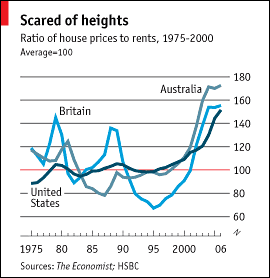
In any case, it is misleading to talk about a soft landing for house prices in Britain and Australia. The market has not really landed yet: prices are still sky-high relative to incomes and rents. The ratio of house prices to rents is a sort of price/earnings ratio for property. Just as the price of a share should equal the discounted present value of future dividends, so the price of a house should reflect the future benefits of ownership, either as rental income or as rent saved by an owner-occupier. Calculations by The Economist show that in Britain and Australia the ratios of prices to rents are respectively 55% and 70% above the long-term average (see chart). By the same gauge property is “overvalued” by 50% in America. Lower real interest rates than in the past would justify higher ratios, but nowhere near all of the rise in house prices.
An OECD study published last year adjusted the price/rent ratio for interest rates and other factors, to estimate how overvalued home prices were around the globe. Updating those figures to take account of price rises since then suggests that housing is now 35-50% overvalued in Britain and Australia and perhaps 20% too dear in America. A return to fair value will mean either rising rents or falling prices. If rents continue to rise at today's pace, many years of stagnant prices will be required to bring the price/rent ratio back to its long-term average. Especially after a giddy ascent, it is too soon to talk about a soft landing before a return to firm ground.
Friday, September 08, 2006
More Evidence of the Coming Rate Cut! "Employers shed jobs for third month"
TAVIA GRANT
Globe and Mail Update
Canadian employers unexpectedly shed 16,000 jobs in August, the third month in a row of declines, as the number of factory workers fell to an eight-year low.
That pushed the jobless rate up a notch to 6.5 per cent — the highest since January — from 6.4 per cent, Statistics Canada said Friday.
It's the first time since 1992 the country has shed jobs for three straight months, according to Bloomberg analytics. August marked the lowest level of employment for manufacturers since March, 1998.
The weaker-than-expected report raised the chance that the Bank of Canada may eventually cut interest rates, should the trend continue. The central bank this week left its key lending rate unchanged at 4.25 per cent.
“The weak report supports the Bank of Canada's stance to hold rates steady for now, and also increases the odds of a rate cut if the weak trend persists through the balance of the year,” said Sarah Hughes, an economist with Bank of Nova Scotia, in a morning note. “Three consecutive soft reports clearly show that momentum has shifted as the year has progressed.”
Overall employment remains strong this year, despite recent losses. The economy has added 194,000 jobs this year, due entirely to full-time positions, matching the pace of job growth south of the border. Alberta alone accounts for 40 per cent of Canada's new jobs.
Gains by adult women this year, at 2.1 per cent, have far exceeded those for adult men, at 0.6 per cent.
In August, a 63,000 drop in part-time jobs outweighed a 47,000 gain in full-time positions.
Among sectors, factories shed 11,300 jobs in August, as a strong Canadian dollar ate profits and competition overseas intensified. The sectors have lost 87,000 jobs since the beginning of 2006.
The construction industry cut 8,900 jobs in August.
Services industries also cut their payrolls. The public administration sector slashed 21,100 jobs and the finance, real-estate and insurance industries, along with education sector, also reduced their headcounts.
Wage gains continue to outpace the rate of inflation. Average hourly wages increased 3.7 per cent from last year, above the most recent annual gain of 2.4 per cent in the consumer price index.
Hourly earnings in Alberta are 8.3 per cent higher than last year.
Economists polled by Bloomberg News had expected the jobless rate to fall to 6.3 per cent, with 15,900 new jobs.
Some economists cautioned not to read too much into today's report, given that it's subject to sampling errors.
“While the monthly employment change from the labour force survey of 60,000 households is closely watched...it is not always a good indicator of near-term economic momentum,” said Ted Carmichael, chief economist at J.P. Morgan.
The standard error on the monthly change is about 30,000, he said.
The six-month jobs trend, which smoothes out monthly volatility, shows average monthly gains of about 25,000 since the beginning of this year based on both the labour force survey and the survey of employment, payrolls and hours, he added.
Robust growth in full-time positions also points to underlying strength in the labour market. Full-time jobs now account for 82.2 per cent of total employment in Canada, the highest proportion in over fifteen years, noted Eric Dubé, an economist at National Bank Financial.
Globe and Mail Update
Canadian employers unexpectedly shed 16,000 jobs in August, the third month in a row of declines, as the number of factory workers fell to an eight-year low.
That pushed the jobless rate up a notch to 6.5 per cent — the highest since January — from 6.4 per cent, Statistics Canada said Friday.
It's the first time since 1992 the country has shed jobs for three straight months, according to Bloomberg analytics. August marked the lowest level of employment for manufacturers since March, 1998.
The weaker-than-expected report raised the chance that the Bank of Canada may eventually cut interest rates, should the trend continue. The central bank this week left its key lending rate unchanged at 4.25 per cent.
“The weak report supports the Bank of Canada's stance to hold rates steady for now, and also increases the odds of a rate cut if the weak trend persists through the balance of the year,” said Sarah Hughes, an economist with Bank of Nova Scotia, in a morning note. “Three consecutive soft reports clearly show that momentum has shifted as the year has progressed.”
Overall employment remains strong this year, despite recent losses. The economy has added 194,000 jobs this year, due entirely to full-time positions, matching the pace of job growth south of the border. Alberta alone accounts for 40 per cent of Canada's new jobs.
Gains by adult women this year, at 2.1 per cent, have far exceeded those for adult men, at 0.6 per cent.
In August, a 63,000 drop in part-time jobs outweighed a 47,000 gain in full-time positions.
Among sectors, factories shed 11,300 jobs in August, as a strong Canadian dollar ate profits and competition overseas intensified. The sectors have lost 87,000 jobs since the beginning of 2006.
The construction industry cut 8,900 jobs in August.
Services industries also cut their payrolls. The public administration sector slashed 21,100 jobs and the finance, real-estate and insurance industries, along with education sector, also reduced their headcounts.
Wage gains continue to outpace the rate of inflation. Average hourly wages increased 3.7 per cent from last year, above the most recent annual gain of 2.4 per cent in the consumer price index.
Hourly earnings in Alberta are 8.3 per cent higher than last year.
Economists polled by Bloomberg News had expected the jobless rate to fall to 6.3 per cent, with 15,900 new jobs.
Some economists cautioned not to read too much into today's report, given that it's subject to sampling errors.
“While the monthly employment change from the labour force survey of 60,000 households is closely watched...it is not always a good indicator of near-term economic momentum,” said Ted Carmichael, chief economist at J.P. Morgan.
The standard error on the monthly change is about 30,000, he said.
The six-month jobs trend, which smoothes out monthly volatility, shows average monthly gains of about 25,000 since the beginning of this year based on both the labour force survey and the survey of employment, payrolls and hours, he added.
Robust growth in full-time positions also points to underlying strength in the labour market. Full-time jobs now account for 82.2 per cent of total employment in Canada, the highest proportion in over fifteen years, noted Eric Dubé, an economist at National Bank Financial.
Wednesday, September 06, 2006
More Evidence of the Coming Rate Cut! "Bank of Canada holds rates unchanged"
DAVID PARKINSON
Globe and Mail Update
The Bank of Canada held its overnight rate target steady Wednesday, a non-move widely expected by the markets, and indicated it expects to remain on hold for the foreseeable future.
The central bank maintained its benchmark rate at 4.25 per cent. It was the second straight rate announcement in which the bank held the rate steady, following seven consecutive 25-basis-point increases that began in September 2005. (A basis point is one-hundredth of a percentage point.)
“Looking forward, the bank continues to expect the Canadian economy to operate at about its production potential, with total CPI inflation returning to the 2-per-cent inflation target in the second half of 2007,” the bank said in its statement accompanying the rate announcement. “In line with this outlook, the current level of the target for the overnight rate is judged at this time to be consistent with achieving the inflation target over the medium term.”
Analysts took the rate-setting statement as evidence that the bank will probably keep rates steady for at least the rest of this year.
Related to this article
Latest Comments Comments
* Start a conversation on this story
The Globe and Mail
“The Bank of Canada remains sidelined, and continues to display a degree of comfort with that position,” said Stewart Hall, market strategist at HSBC Securities Canada Inc. in Toronto.
The Bank of Canada said the underlying trends in the Canadian economy remain in line with “the broad thrust” of its output and inflation projections contained in its July monetary policy report update, which was issued on July 13, two days after the previous rate announcement. It said Canadian economic growth in the second quarter was “somewhat below the bank's expectations,” while consumer price index (CPI) inflation was “slightly higher” than expected.
It added that global economic growth remains “solid,” although U.S. growth has moderated.
The central bank said the key downside risk for the Canadian economy lies south of the border, where the housing market has recently developed some cracks that threaten to slow consumer demand and, by extension, demand for Canadian exports. This echoes a warning made by Bank of Canada Governor David Dodge in July, when the bank issued the monetary policy update. It said the key upside risks involve the momentum of domestic housing prices and household spending.
The bank said both the upside and downside risks “appear to be a little greater than they were in July,” but overall, “risks are roughly balanced.”
The Bank of Canada adjusts its interest-rate policy eight times a year. Wednesday's announcement was the sixth of this year. The next rate announcement is scheduled for Oct. 17. It will issue its next monetary policy report on Oct. 19.
While analysts agreed that the statement was largely in line with the bank's previously stated stand-pat position on rates, some felt it was less dovish than they had anticipated. Some noted, for instance, that the bank is no longer saying that the balance of risks in its outlook is tilted slightly to the downside, and no longer mentions the high Canadian dollar as a downside risk factor.
However, others noted that the bank is now talking about the Canadian economy operating at about its production potential, rather than slightly above potential as it said in the previous rate announcement in July. Some took this as evidence that output expectations are easing as export demand is poised to slow, and argued that rates could head lower before they head higher.
“Although the Canadian economy is in fundamentally better health than its U.S. counterpart – which should allow it to outperform on the growth front – the economic slowdown that is materializing in the U.S. will inevitably spill over to this side of the border,” said Marc Lévesque, chief North American forex and fixed-income strategist at TD Securities. “As a result, we are expecting several quarters of below-potential growth — and the next Bank of Canada move not to be a hike, but a cut in 2007.”
Globe and Mail Update
The Bank of Canada held its overnight rate target steady Wednesday, a non-move widely expected by the markets, and indicated it expects to remain on hold for the foreseeable future.
The central bank maintained its benchmark rate at 4.25 per cent. It was the second straight rate announcement in which the bank held the rate steady, following seven consecutive 25-basis-point increases that began in September 2005. (A basis point is one-hundredth of a percentage point.)
“Looking forward, the bank continues to expect the Canadian economy to operate at about its production potential, with total CPI inflation returning to the 2-per-cent inflation target in the second half of 2007,” the bank said in its statement accompanying the rate announcement. “In line with this outlook, the current level of the target for the overnight rate is judged at this time to be consistent with achieving the inflation target over the medium term.”
Analysts took the rate-setting statement as evidence that the bank will probably keep rates steady for at least the rest of this year.
Related to this article
Latest Comments Comments
* Start a conversation on this story
The Globe and Mail
“The Bank of Canada remains sidelined, and continues to display a degree of comfort with that position,” said Stewart Hall, market strategist at HSBC Securities Canada Inc. in Toronto.
The Bank of Canada said the underlying trends in the Canadian economy remain in line with “the broad thrust” of its output and inflation projections contained in its July monetary policy report update, which was issued on July 13, two days after the previous rate announcement. It said Canadian economic growth in the second quarter was “somewhat below the bank's expectations,” while consumer price index (CPI) inflation was “slightly higher” than expected.
It added that global economic growth remains “solid,” although U.S. growth has moderated.
The central bank said the key downside risk for the Canadian economy lies south of the border, where the housing market has recently developed some cracks that threaten to slow consumer demand and, by extension, demand for Canadian exports. This echoes a warning made by Bank of Canada Governor David Dodge in July, when the bank issued the monetary policy update. It said the key upside risks involve the momentum of domestic housing prices and household spending.
The bank said both the upside and downside risks “appear to be a little greater than they were in July,” but overall, “risks are roughly balanced.”
The Bank of Canada adjusts its interest-rate policy eight times a year. Wednesday's announcement was the sixth of this year. The next rate announcement is scheduled for Oct. 17. It will issue its next monetary policy report on Oct. 19.
While analysts agreed that the statement was largely in line with the bank's previously stated stand-pat position on rates, some felt it was less dovish than they had anticipated. Some noted, for instance, that the bank is no longer saying that the balance of risks in its outlook is tilted slightly to the downside, and no longer mentions the high Canadian dollar as a downside risk factor.
However, others noted that the bank is now talking about the Canadian economy operating at about its production potential, rather than slightly above potential as it said in the previous rate announcement in July. Some took this as evidence that output expectations are easing as export demand is poised to slow, and argued that rates could head lower before they head higher.
“Although the Canadian economy is in fundamentally better health than its U.S. counterpart – which should allow it to outperform on the growth front – the economic slowdown that is materializing in the U.S. will inevitably spill over to this side of the border,” said Marc Lévesque, chief North American forex and fixed-income strategist at TD Securities. “As a result, we are expecting several quarters of below-potential growth — and the next Bank of Canada move not to be a hike, but a cut in 2007.”
Tuesday, September 05, 2006
Inversion and reversion
Sep 5th 2006 | LONDON
From Economist.com
Some things are too good to last
THE outlook for financial markets over the next 12 months depends on the answers to two questions. First, what does it mean for the American economy that short rates are above long bond yields—that, in the jargon, the yield curve is inverted? Second, can companies continue to earn today’s high level of profits as a share of GDP?
Take the optimistic view and you can construct a bullish case for equities. The yield curve is not a signal of impending recession, simply a reflection of greater confidence in the ability of central banks to control inflation. And with the balance of power in the global economy having shifted from workers to employers, there is no need for corporate profits to come under pressure.
The pessimistic view is that the yield curve does indeed signal economic troubles as it has in the past—and at a time when profits are already cyclically high. If so, profits and share prices could be in for a double blow as the economy slows and margins come under pressure.
Buttonwood is a great believer in reversion to the mean. Because the optimistic school implicitly argues that “things are different this time”, it is tempting to side automatically with the pessimists.
But the facts are a little more complex. The standard assumption in finance textbooks has been that long-term rates should be above short rates because borrowers must pay a premium for illiquidity, just as UK building societies pay higher rates to savers willing to lock away their money for 90 days.
An upward-sloping yield curve has come to be perceived as “normal”. Hence the use of the term “inverted” to describe the situation today.
But as Andrew Smithers, of the economic consultancy Smithers & Co, points out, in the 19th century an inverted yield curve was the norm. It was only in the 20th century, when inflation unexpectedly surged, that the curve became upward-sloping. Bond investors demanded a premium for the risk that inflation would erode the real value of their holdings. Now that inflation has receded, perhaps this premium can disappear.
Another way to think about this is to remember that volatile assets should carry a risk premium. Over the short term (less than 12 months), bonds are usually more volatile than cash. But over a period of several years, this may not be so, since short rates are adjusted frequently by central banks in an attempt to damp the economic cycle and keep long-run inflation stable. Investors, such as pension funds, with a long-term horizon, have no need for bonds to offer a risk premium. Indeed, in Britain, because of actuarial theory and accounting regulations, the very longest-dated government bonds are much sought after and offer lower yields than cash or short-term bonds.
A flat, or inverted, yield curve could well become much more common than in the past 50 years. Even the recent direction of bond yields does not necessarily provide support for the pessimists. Ten-year Treasury bond yields have dropped from 5.24% in June to 4.74% this week. But if that is because investors are nervous about global growth, then it is hard to explain why emerging markets have rebounded so strongly from their June lows or why commodity prices are just 6% below the year’s high.
The case for profits to revert to the mean looks rather more clear cut. After all, in both the United States and Britain, profits are at a 40-year high as a share of GDP. Figures from UBS show that corporate profits are taking their biggest bite of GDP in the G7 countries in the past quarter of a century.
Optimists say that globalisation has changed the rules. The entry of China, India and the ex-Soviet block into the global economy has, in effect, doubled the labour force. That has enabled companies to expand without meeting one of the normal constraints of the economic cycle: rising wages. In the early part of this decade, lower interest rates also slashed debt costs.
Neither the increases in commodity prices nor the recent tightening of monetary policy seems to have made much of a dent in this: profits in America and Europe are still rising at double-digit percentage rates.
But how long can this trend continue? Theory would suggest that, even if the odds have shifted in favour of capital, balancing factors should come into play. If returns on capital are high, more companies will be created and existing companies will invest more money. The resulting competition should drive down returns. Only if new businesses face barriers to entry could high returns be sustained. That is unlikely given how competition seems even more intense in a globalised world.
However, reversion to the mean could take years and, in the interim, investors will not be too concerned if companies are returning cash by the fistful in the form of buy-backs, higher dividends and takeover deals.
People typically see corporate cashflow as a strong support for the market and James Montier of Dresdner Kleinwort says that buy-backs could add three percentage points to the American dividend yield in 2006.
However, today’s high level of buy-backs may indicate that companies are aware their earnings strength is temporary. Managers are reluctant to increase dividends in the face of a transient boost to profits, lest they have to cut their payments in later years—a signal that is taken badly by the markets.
Mr Montier finds a close correlation between net repurchases of equity in the American market and the deviation of earnings from their trend value. Both are at their highest level in the past 20 years.
So perhaps investors should not read too much into the inverted yield curve. On the other hand, they should be concerned about profits, which look unsustainably high. With the Conference Board’s measure of chief-executive confidence showing a recent decline, it looks as though companies are starting to fear that the best years of this cycle are behind them.
From Economist.com
Some things are too good to last
THE outlook for financial markets over the next 12 months depends on the answers to two questions. First, what does it mean for the American economy that short rates are above long bond yields—that, in the jargon, the yield curve is inverted? Second, can companies continue to earn today’s high level of profits as a share of GDP?
Take the optimistic view and you can construct a bullish case for equities. The yield curve is not a signal of impending recession, simply a reflection of greater confidence in the ability of central banks to control inflation. And with the balance of power in the global economy having shifted from workers to employers, there is no need for corporate profits to come under pressure.
The pessimistic view is that the yield curve does indeed signal economic troubles as it has in the past—and at a time when profits are already cyclically high. If so, profits and share prices could be in for a double blow as the economy slows and margins come under pressure.
Buttonwood is a great believer in reversion to the mean. Because the optimistic school implicitly argues that “things are different this time”, it is tempting to side automatically with the pessimists.
But the facts are a little more complex. The standard assumption in finance textbooks has been that long-term rates should be above short rates because borrowers must pay a premium for illiquidity, just as UK building societies pay higher rates to savers willing to lock away their money for 90 days.
An upward-sloping yield curve has come to be perceived as “normal”. Hence the use of the term “inverted” to describe the situation today.
But as Andrew Smithers, of the economic consultancy Smithers & Co, points out, in the 19th century an inverted yield curve was the norm. It was only in the 20th century, when inflation unexpectedly surged, that the curve became upward-sloping. Bond investors demanded a premium for the risk that inflation would erode the real value of their holdings. Now that inflation has receded, perhaps this premium can disappear.
Another way to think about this is to remember that volatile assets should carry a risk premium. Over the short term (less than 12 months), bonds are usually more volatile than cash. But over a period of several years, this may not be so, since short rates are adjusted frequently by central banks in an attempt to damp the economic cycle and keep long-run inflation stable. Investors, such as pension funds, with a long-term horizon, have no need for bonds to offer a risk premium. Indeed, in Britain, because of actuarial theory and accounting regulations, the very longest-dated government bonds are much sought after and offer lower yields than cash or short-term bonds.
A flat, or inverted, yield curve could well become much more common than in the past 50 years. Even the recent direction of bond yields does not necessarily provide support for the pessimists. Ten-year Treasury bond yields have dropped from 5.24% in June to 4.74% this week. But if that is because investors are nervous about global growth, then it is hard to explain why emerging markets have rebounded so strongly from their June lows or why commodity prices are just 6% below the year’s high.
The case for profits to revert to the mean looks rather more clear cut. After all, in both the United States and Britain, profits are at a 40-year high as a share of GDP. Figures from UBS show that corporate profits are taking their biggest bite of GDP in the G7 countries in the past quarter of a century.
Optimists say that globalisation has changed the rules. The entry of China, India and the ex-Soviet block into the global economy has, in effect, doubled the labour force. That has enabled companies to expand without meeting one of the normal constraints of the economic cycle: rising wages. In the early part of this decade, lower interest rates also slashed debt costs.
Neither the increases in commodity prices nor the recent tightening of monetary policy seems to have made much of a dent in this: profits in America and Europe are still rising at double-digit percentage rates.
But how long can this trend continue? Theory would suggest that, even if the odds have shifted in favour of capital, balancing factors should come into play. If returns on capital are high, more companies will be created and existing companies will invest more money. The resulting competition should drive down returns. Only if new businesses face barriers to entry could high returns be sustained. That is unlikely given how competition seems even more intense in a globalised world.
However, reversion to the mean could take years and, in the interim, investors will not be too concerned if companies are returning cash by the fistful in the form of buy-backs, higher dividends and takeover deals.
People typically see corporate cashflow as a strong support for the market and James Montier of Dresdner Kleinwort says that buy-backs could add three percentage points to the American dividend yield in 2006.
However, today’s high level of buy-backs may indicate that companies are aware their earnings strength is temporary. Managers are reluctant to increase dividends in the face of a transient boost to profits, lest they have to cut their payments in later years—a signal that is taken badly by the markets.
Mr Montier finds a close correlation between net repurchases of equity in the American market and the deviation of earnings from their trend value. Both are at their highest level in the past 20 years.
So perhaps investors should not read too much into the inverted yield curve. On the other hand, they should be concerned about profits, which look unsustainably high. With the Conference Board’s measure of chief-executive confidence showing a recent decline, it looks as though companies are starting to fear that the best years of this cycle are behind them.
Wednesday, August 30, 2006
China/Canada Visa Agreement Will have a Huge Effect on Downtown Vancouver Real Estate
The faltering Canada/China Tourism agreement that will give Canada approved destination status for Chinese tourists will have a vast impact on Vancouver's real estate market.
With the worlds largest population and an economy growing at a blistering pace, China is quickly developing a an entire demographic of people with the means to invest in overseas property. The experience of the 1980's with people from Hong Kong moving here to hedge their bets over the 1997 Chinese take over of Hong Kong will be small potatoes compared to what is coming.
I was a Cascadia Forum talk given by Harmony Airways CEO Gary Collins and he said the biggest obstacle to an agreement was the Canadian government rather than the Chinese.
I have seen a small example of this with the growing numbers of Korean investors buying on Marinaside Crescent. This was caused after the Korean government imposed a series of tough antispeculation measures to curb rising housing prices in the Korean real estate market. But investment on this scale would have been impossible had there not been an easing of visa restrictioons on South Koreans in Canada during the 90's, much like what is proposed between Canada and China.
When this Canada/China deal goes through we will feel it in the Downtown property market.
With the worlds largest population and an economy growing at a blistering pace, China is quickly developing a an entire demographic of people with the means to invest in overseas property. The experience of the 1980's with people from Hong Kong moving here to hedge their bets over the 1997 Chinese take over of Hong Kong will be small potatoes compared to what is coming.
I was a Cascadia Forum talk given by Harmony Airways CEO Gary Collins and he said the biggest obstacle to an agreement was the Canadian government rather than the Chinese.
I have seen a small example of this with the growing numbers of Korean investors buying on Marinaside Crescent. This was caused after the Korean government imposed a series of tough antispeculation measures to curb rising housing prices in the Korean real estate market. But investment on this scale would have been impossible had there not been an easing of visa restrictioons on South Koreans in Canada during the 90's, much like what is proposed between Canada and China.
When this Canada/China deal goes through we will feel it in the Downtown property market.
Falling Oil Prices May Spur the BoC to Lower Interest Rates as Inflation Pressures Ease
The recent decline in oil prices may speed up the Bank of Canada's plan's to reduce interest rates over the next 6-9 months. The recent run up in inflation in Canada has been caused by the high price of oil in two ways. First it increases the cost of energy to consumers and businesses and second it stokes the economies of the nations oil patch.
The effect of lower energy prices will have a larger effect on energy consumers costs than it will on oil patch revenue, but it will ease inflationary pressures on BoC decision makers concerned about inflation.
What this means for the Downtown Vancouver Real Estate Market;
A drop in rates will increase affordability and I think will create upward pressure on prices, though it may not increase the number of transactions. The market has slowed over the summer as it does in a more normal market, but I predict a hot autumn for the Downtown Market
The effect of lower energy prices will have a larger effect on energy consumers costs than it will on oil patch revenue, but it will ease inflationary pressures on BoC decision makers concerned about inflation.
What this means for the Downtown Vancouver Real Estate Market;
A drop in rates will increase affordability and I think will create upward pressure on prices, though it may not increase the number of transactions. The market has slowed over the summer as it does in a more normal market, but I predict a hot autumn for the Downtown Market
U.S. economy grows at a 2.9% pace in spring
Associated Press
Washington — The economy grew at a 2.9 per cent annual rate in the spring — better than first estimated but nowhere near the brisk pace logged in the winter, another sign of slowing business growth. Inflation marched higher.
The latest snapshot of economic activity, released by the Commerce Department Wednesday, showed that gross domestic product in the April-to-June quarter increased slightly more than the 2.5 per cent pace first reported a month ago. That upgrade mostly reflected an improvement in the country's trade picture and stronger inventory building by businesses.
The upward revision, though, didn't change the big picture of the economy: In the spring, it slowed sharply from the first quarter's 5.6 per cent pace, the strongest growth spurt in 2 1/2 years, as consumers and businesses tightened the belt.
Gross domestic product measures the value of all goods and services produced within the United States and is considered the best barometer of the country's economic standing.
The second-quarter's showing was slightly less than the 3 per cent pace that analysts were expecting.
Even though the economy lost momentum in the spring compared with the winter, inflation moved higher.
An inflation gauge closely watched by the Federal Reserve showed that core prices — excluding food and energy — advanced at a rate of 2.8 per cent in the second quarter, up from a 2.1 per cent pace in the first quarter.
The second quarter's increase matched that seen in the first quarter of 2001 and hasn't been higher since the third quarter of 1994 when this inflation measure rose at a 3.2 per cent pace.
With the economy slowing, the Federal Reserve earlier this month halted a rate-raising campaign that lasted for more than two years. The decision was a “close call” minutes of the meeting revealed.
The Fed meets next on Sept. 20 and there's uncertainty about its next move. Some economists believe rates will be left alone again, while others think a rate increase will be needed to keep inflation in check.
Fed policy-makers, concerned about inflation, are keeping the door open to a rate increase; but they are betting that inflation pressures will gradually lessen as economic growth moderates.
Oil prices, which hit a new record closing high of $77.03 a barrel in mid-July, have retreated and are hovering below $70 a barrel.
The average retail price of gasoline nationwide has fallen by nearly 20 cents over the past three weeks to $2.85 a gallon.
However, high energy prices forced consumers and businesses alike to tighten their belts in the second quarter, a big reason why the economy slowed so sharply from the prior quarter.
Consumer spending increased at a rate of 2.6 per cent, a tad better than first estimated for the second quarter but a steep deceleration from the first quarter's 4.8 per cent pace.
Businesses, meanwhile, cut spending on equipment and software at a 1.6 per cent pace, deeper than first estimated and a reversal from the 15.6 per cent growth rate of the first quarter.
Spending on home building was slashed at a 9.8 percent rate in the second quarter — a sharper cut than previously estimated and more evidence that the once highflying housing sector has lost altitude.
The 2.9 per cent growth rate logged in the second quarter was the slowest since the final quarter of 2005, when the economy, reeling from fallout from the Gulf Coast hurricanes, expanded at a pace of only 1.8 per cent.
Voters' perceptions of the economy's health may influence their choice at the polls in November.
President Bush has been touting his economic policies but is getting relatively low marks from the public for his economic stewardship.
Economic growth in the second half of this year is expected to be remain somewhat subdued at a pace of around 2.5 per cent to 3 per cent, according to some analysts' projections.
Washington — The economy grew at a 2.9 per cent annual rate in the spring — better than first estimated but nowhere near the brisk pace logged in the winter, another sign of slowing business growth. Inflation marched higher.
The latest snapshot of economic activity, released by the Commerce Department Wednesday, showed that gross domestic product in the April-to-June quarter increased slightly more than the 2.5 per cent pace first reported a month ago. That upgrade mostly reflected an improvement in the country's trade picture and stronger inventory building by businesses.
The upward revision, though, didn't change the big picture of the economy: In the spring, it slowed sharply from the first quarter's 5.6 per cent pace, the strongest growth spurt in 2 1/2 years, as consumers and businesses tightened the belt.
Gross domestic product measures the value of all goods and services produced within the United States and is considered the best barometer of the country's economic standing.
The second-quarter's showing was slightly less than the 3 per cent pace that analysts were expecting.
Even though the economy lost momentum in the spring compared with the winter, inflation moved higher.
An inflation gauge closely watched by the Federal Reserve showed that core prices — excluding food and energy — advanced at a rate of 2.8 per cent in the second quarter, up from a 2.1 per cent pace in the first quarter.
The second quarter's increase matched that seen in the first quarter of 2001 and hasn't been higher since the third quarter of 1994 when this inflation measure rose at a 3.2 per cent pace.
With the economy slowing, the Federal Reserve earlier this month halted a rate-raising campaign that lasted for more than two years. The decision was a “close call” minutes of the meeting revealed.
The Fed meets next on Sept. 20 and there's uncertainty about its next move. Some economists believe rates will be left alone again, while others think a rate increase will be needed to keep inflation in check.
Fed policy-makers, concerned about inflation, are keeping the door open to a rate increase; but they are betting that inflation pressures will gradually lessen as economic growth moderates.
Oil prices, which hit a new record closing high of $77.03 a barrel in mid-July, have retreated and are hovering below $70 a barrel.
The average retail price of gasoline nationwide has fallen by nearly 20 cents over the past three weeks to $2.85 a gallon.
However, high energy prices forced consumers and businesses alike to tighten their belts in the second quarter, a big reason why the economy slowed so sharply from the prior quarter.
Consumer spending increased at a rate of 2.6 per cent, a tad better than first estimated for the second quarter but a steep deceleration from the first quarter's 4.8 per cent pace.
Businesses, meanwhile, cut spending on equipment and software at a 1.6 per cent pace, deeper than first estimated and a reversal from the 15.6 per cent growth rate of the first quarter.
Spending on home building was slashed at a 9.8 percent rate in the second quarter — a sharper cut than previously estimated and more evidence that the once highflying housing sector has lost altitude.
The 2.9 per cent growth rate logged in the second quarter was the slowest since the final quarter of 2005, when the economy, reeling from fallout from the Gulf Coast hurricanes, expanded at a pace of only 1.8 per cent.
Voters' perceptions of the economy's health may influence their choice at the polls in November.
President Bush has been touting his economic policies but is getting relatively low marks from the public for his economic stewardship.
Economic growth in the second half of this year is expected to be remain somewhat subdued at a pace of around 2.5 per cent to 3 per cent, according to some analysts' projections.
Falling gas prices reflect break from adversity
PATRICK BRETHOUR
CALGARY — Pump prices have dropped below $1 a litre for the first time in five months -- and the cost of a fill-up is likely to drop even more in coming weeks.
It is a precise reversal from this time last year, when hurricane Katrina battered the U.S. Gulf Coast and devastated refineries in the region. Then, tight supplies swelled the wholesale cost of gasoline -- and the coffers of big oil companies -- and sent pump prices soaring to unprecedented levels in North America, as high as $1.39 a litre in Canada.
But this week, hurricane Ernesto was downgraded to a tropical storm and veered away from the refineries and oil fields of Texas, Louisiana and Mississippi. (Last night, it made landfall in Florida, drenching southern counties but causing little damage.)
With last year's disaster scenario averted, oil prices yesterday dipped to their lowest level in more than two months -- an indication of further declines in the cost of gasoline.
The refineries are safe, gasoline inventories are healthy and the margins for oil companies are falling fast. And that gives consumers, hammered by pricey gasoline for much of the last year, a long-awaited break at the pumps, courtesy of the squeeze on industry profits.
Gasoline prices are likely to fall even further, since the summer driving season is gearing down, and the cost of crude oil is drifting downward. "I suspect there's more to come," said Cathy Hay, an analyst at M. J. Ervin & Associates Inc.
Already prices have dropped substantially across Canada, according to the weekly survey by M. J. Ervin. Nationwide, the average cost of a litre of regular gasoline dropped to 96.9 cents, the lowest price since March 14.
The biggest decline was in Victoria, where pump prices fell 8.8 cents a litre. But motorists in Hamilton enjoyed the cheapest gasoline in the country, according to the M. J. Ervin survey, paying just 88.7 cents a litre. Elsewhere in the competitive Southern Ontario market, Toronto declined to 88.9 cents a litre.
In Labrador City, however, where prices are set by a government agency, a litre of gasoline still costs $1.204, unchanged from last week and the priciest in the country.
Ms. Hay said she believes that prices have room to fall in Newfoundland and Western Canada. Calgary and Edmonton, despite being located in oil-rich Alberta, had far higher prices for gasoline than in the East. In Calgary, a litre cost 98.8 cents, while Edmonton drivers got a slightly better deal, at 97.8 cents a litre.
The decline in gasoline prices is just one part of a larger drop in the cost of energy in recent days, as the fears ease of calamitous weather in the United States and apocalyptic confrontations in the Middle East.
Ernesto has turned out to be more bluster than disaster, deflating concerns that hurricane seasons were becoming consistently more destructive, said Kyle Cooper, director of research at IAF Advisors in Houston.
Another major hurricane could yet batter the U.S. coast, but Mr. Cooper said refining operations are better prepared than a year ago, with backup generators and stockpiles of repair materials at hand.
On the political front, the end of intense violence in Lebanon has dampened pressures on crude prices. Even the looming confrontation between Iran and the United States over the former's uranium-enrichment efforts could not halt yesterday's slide in oil prices, which fell below $70 (U.S.) a barrel for the first time since June.
"The tensions in Iran are going to be there for a while, but for now there's nothing that says there's going to be any threat to our supply," said Olivier Jakob of Petromatrix.
And another bogeyman of oil traders from earlier this month was partly banished yesterday, when BP PLC said it had restored output from its Prudhoe Bay field in Alaska to about 200,000 barrels a day, half the capacity lost when the British oil giant said corrosion had forced it to curtail production.
Mr. Cooper said oil prices could drop another $20 a barrel, if the relative calm holds and deprives speculators of a rallying point to send crude soaring again.
CALGARY — Pump prices have dropped below $1 a litre for the first time in five months -- and the cost of a fill-up is likely to drop even more in coming weeks.
It is a precise reversal from this time last year, when hurricane Katrina battered the U.S. Gulf Coast and devastated refineries in the region. Then, tight supplies swelled the wholesale cost of gasoline -- and the coffers of big oil companies -- and sent pump prices soaring to unprecedented levels in North America, as high as $1.39 a litre in Canada.
But this week, hurricane Ernesto was downgraded to a tropical storm and veered away from the refineries and oil fields of Texas, Louisiana and Mississippi. (Last night, it made landfall in Florida, drenching southern counties but causing little damage.)
With last year's disaster scenario averted, oil prices yesterday dipped to their lowest level in more than two months -- an indication of further declines in the cost of gasoline.
The refineries are safe, gasoline inventories are healthy and the margins for oil companies are falling fast. And that gives consumers, hammered by pricey gasoline for much of the last year, a long-awaited break at the pumps, courtesy of the squeeze on industry profits.
Gasoline prices are likely to fall even further, since the summer driving season is gearing down, and the cost of crude oil is drifting downward. "I suspect there's more to come," said Cathy Hay, an analyst at M. J. Ervin & Associates Inc.
Already prices have dropped substantially across Canada, according to the weekly survey by M. J. Ervin. Nationwide, the average cost of a litre of regular gasoline dropped to 96.9 cents, the lowest price since March 14.
The biggest decline was in Victoria, where pump prices fell 8.8 cents a litre. But motorists in Hamilton enjoyed the cheapest gasoline in the country, according to the M. J. Ervin survey, paying just 88.7 cents a litre. Elsewhere in the competitive Southern Ontario market, Toronto declined to 88.9 cents a litre.
In Labrador City, however, where prices are set by a government agency, a litre of gasoline still costs $1.204, unchanged from last week and the priciest in the country.
Ms. Hay said she believes that prices have room to fall in Newfoundland and Western Canada. Calgary and Edmonton, despite being located in oil-rich Alberta, had far higher prices for gasoline than in the East. In Calgary, a litre cost 98.8 cents, while Edmonton drivers got a slightly better deal, at 97.8 cents a litre.
The decline in gasoline prices is just one part of a larger drop in the cost of energy in recent days, as the fears ease of calamitous weather in the United States and apocalyptic confrontations in the Middle East.
Ernesto has turned out to be more bluster than disaster, deflating concerns that hurricane seasons were becoming consistently more destructive, said Kyle Cooper, director of research at IAF Advisors in Houston.
Another major hurricane could yet batter the U.S. coast, but Mr. Cooper said refining operations are better prepared than a year ago, with backup generators and stockpiles of repair materials at hand.
On the political front, the end of intense violence in Lebanon has dampened pressures on crude prices. Even the looming confrontation between Iran and the United States over the former's uranium-enrichment efforts could not halt yesterday's slide in oil prices, which fell below $70 (U.S.) a barrel for the first time since June.
"The tensions in Iran are going to be there for a while, but for now there's nothing that says there's going to be any threat to our supply," said Olivier Jakob of Petromatrix.
And another bogeyman of oil traders from earlier this month was partly banished yesterday, when BP PLC said it had restored output from its Prudhoe Bay field in Alaska to about 200,000 barrels a day, half the capacity lost when the British oil giant said corrosion had forced it to curtail production.
Mr. Cooper said oil prices could drop another $20 a barrel, if the relative calm holds and deprives speculators of a rallying point to send crude soaring again.
Tuesday, August 22, 2006
Canadian inflation rises unexpectedly
Canadian inflation rises unexpectedly
RICHARD BLACKWELL
Globe and Mail Update
Higher gas costs helped boost Canadian consumer prices by 0.1 per cent in July, despite a one percentage point reduction in the goods and services tax that took effect at the beginning of the month.
The GST change was estimated to have cut overall prices by about 0.5 per cent, so inflation is actually up fairly sharply in the month. Any tax savings were “more than eaten up by higher underlying prices for some key goods and services,” said Warren Lovely, a senior economist at CIBC World Markets Inc.
Increases in energy costs were particularly steep, with the price of gasoline rising 4.6 per cent in July. Fresh fruit was also a contributor, with prices jumping 7.4 per cent between June and July.
The monthly inflation rate was considerably higher than most economists had predicted. The consensus forecast was for a 0.3 per cent drop in the July rate.
But economists said the higher-than-expected numbers are not enough to get the Bank of Canada to change its policy on interest rates, which are on hold for the time being.
The year-over-year inflation rate fell slightly, to 2.4 per cent in July, compared to 2.5 per cent in June and 2.8 per cent in May, Statistics Canada said in its release Tuesday morning.
The annual inflation rate was strongly affected by energy prices, with gasoline up 16.1 per cent from a year earlier. In some provinces, the cost of gas rose even faster — Saskatchewan residents paid 19.2 per cent more in July of this year than they did in the same month of 2005.
Electricity prices also climbed sharply in the year, by 6.3 per cent.
On the other side of the coin, prices of computer equipment and supplies dropped more than 17 per cent over the year, and video equipment fell more than 11 per cent. Men's clothing prices fell 3.7 per cent year-over-year, while women's clothing dropped 3.4 per cent.
Alberta showed the highest yearly increase in CPI, at 4.3 per cent.
Core inflation, which excludes the eight most volatile items in the index — including fruits, vegetables and energy — was at 1.5 per cent on an annual basis, down from 1.7 per cent in June.
Economists noted that the most of the upward pressure on inflation is coming from non-core items.
With the core inflation rate fairly stable, the Bank of Canada is unlikely to change its stance that interest rates hikes are at an end, said Adrienne Warren, senior economist at Bank of Nova Scotia. “The Bank of Canada is pretty firmly on hold for the time being.”
Evidence that Canadian economy activity has some weaknesses — such as Monday's soft retail sales figures — will balance any concerns over rising inflation, she said.
Still, Ms. Warren said, “rate cuts, for the time being, are not forthcoming.
RICHARD BLACKWELL
Globe and Mail Update
Higher gas costs helped boost Canadian consumer prices by 0.1 per cent in July, despite a one percentage point reduction in the goods and services tax that took effect at the beginning of the month.
The GST change was estimated to have cut overall prices by about 0.5 per cent, so inflation is actually up fairly sharply in the month. Any tax savings were “more than eaten up by higher underlying prices for some key goods and services,” said Warren Lovely, a senior economist at CIBC World Markets Inc.
Increases in energy costs were particularly steep, with the price of gasoline rising 4.6 per cent in July. Fresh fruit was also a contributor, with prices jumping 7.4 per cent between June and July.
The monthly inflation rate was considerably higher than most economists had predicted. The consensus forecast was for a 0.3 per cent drop in the July rate.
But economists said the higher-than-expected numbers are not enough to get the Bank of Canada to change its policy on interest rates, which are on hold for the time being.
The year-over-year inflation rate fell slightly, to 2.4 per cent in July, compared to 2.5 per cent in June and 2.8 per cent in May, Statistics Canada said in its release Tuesday morning.
The annual inflation rate was strongly affected by energy prices, with gasoline up 16.1 per cent from a year earlier. In some provinces, the cost of gas rose even faster — Saskatchewan residents paid 19.2 per cent more in July of this year than they did in the same month of 2005.
Electricity prices also climbed sharply in the year, by 6.3 per cent.
On the other side of the coin, prices of computer equipment and supplies dropped more than 17 per cent over the year, and video equipment fell more than 11 per cent. Men's clothing prices fell 3.7 per cent year-over-year, while women's clothing dropped 3.4 per cent.
Alberta showed the highest yearly increase in CPI, at 4.3 per cent.
Core inflation, which excludes the eight most volatile items in the index — including fruits, vegetables and energy — was at 1.5 per cent on an annual basis, down from 1.7 per cent in June.
Economists noted that the most of the upward pressure on inflation is coming from non-core items.
With the core inflation rate fairly stable, the Bank of Canada is unlikely to change its stance that interest rates hikes are at an end, said Adrienne Warren, senior economist at Bank of Nova Scotia. “The Bank of Canada is pretty firmly on hold for the time being.”
Evidence that Canadian economy activity has some weaknesses — such as Monday's soft retail sales figures — will balance any concerns over rising inflation, she said.
Still, Ms. Warren said, “rate cuts, for the time being, are not forthcoming.
Thursday, August 17, 2006
How the GST cut affects housing prices
By Peter Diekmeyer ? Bankrate.com
For most Canadians, the one-per cent cut in the Goods and Services Tax, or GST, that came into
effect July 1 is unlikely to be as big a deal as politicians are making it out to be. On a $3
hamburger purchase, the cut will save you a grand total of 3 cents. Worse, on items that have the
GST already included in the price, there's no guarantee that these savings will be passed on to
consumers.
But for prospective home buyers, the tax cut could mean thousands of dollars in their pockets.
That said, it's a complex matter, and the implications vary depending on whether you are buying a
new or used home. And strange as it may seem, in theory at least, if you are selling an existing
home, the GST cut could eventually end up costing you money.
Buyers of new homes are big winners
The good news is that the GST cut provides a major benefit to new home buyers, says Dave Benbow,
president of the Canadian Home Builders Association. "The action improves housing affordability
for many Canadians," he says. "It's also good news for owners who are considering home
renovations."
The bad news is that for many home buyers, the GST cut will not be as generous as it appears at
first glance. That's because buyers of new homes whose houses cost less than $350,000 already
benefit from a 36 per cent rebate of the GST they pay on their properties. This rebate is phased
out gradually for buyers of new homes priced between $350,000 and $450,000, and there is no
rebate at all for buyers of homes worth more than $450,000.
The upshot is that the more expensive the home you buy, the greater your savings, both in dollar
and percentage terms. For example, a buyer of a new home costing $350,000 will save $2,310, which
works out to one per cent of the home price, less the 36 per cent of the rebate. However, if you
buy a home costing $500,000, you'll benefit from the full one-per cent cut and will save a cool
$5,000.
Mixed news for the existing home market
Unlike buyers of new homes, people who purchase existing homes don't pay GST. But that doesn't
mean that they don't benefit from the cut. "Reducing the GST rate will have the effect of
reducing the costs associated with buying or selling a home," says Pierre Beauchamp, chief
executive officer of the Canadian Real Estate Association, or CREA. "It would also have an impact
on the associated costs of moving a house."
Last year, CREA commissioned a study from Clayton Research, which listed many of those costs.
Among those cited were renovations, as well as the purchase of furniture and major appliances.
Real estate agents' fees will also cost less as a result of the cut.
In fact, the GST cut will likely lead to downward pressure on the prices of existing homes,
despite the fact that no GST is charged on them. That's because existing homes and new homes
often compete for the same pool of buyers. And although the process is informal at best, price
changes in one category tend, over time, to be mirrored in the other.
But what is good news for existing home buyers could end up being bad news for sellers of
existing homes. That's because the houses they are selling compete with builders' new offerings,
which are now cheaper due to the GST cut. As a result, existing home buyers will be unlikely to
command as much for their homes as they would have if the GST cuts had not been introduced.
On the other hand, sellers of existing homes have seen their property values rise considerably in
recent years due to other factors that provide direct benefits to existing home demand, such as
cheap interest rates and the strong economy. As a result, most are unlikely to worry too much
about the indirect effects the GST cut may have.
Another cut to come
The key point is that however complex the differing implications of the GST cut are on various
types of homes, the savings are real and could get better.
That's because the recent one-per cent GST cut is only half of what the Harper government
promised during the election. Although a time table for the second cut, which would bring the GST
down to five per cent, has yet to be announced, the good times just may continue to roll.
Peter Diekmeyer is a Montreal-based business and economics writer.
For most Canadians, the one-per cent cut in the Goods and Services Tax, or GST, that came into
effect July 1 is unlikely to be as big a deal as politicians are making it out to be. On a $3
hamburger purchase, the cut will save you a grand total of 3 cents. Worse, on items that have the
GST already included in the price, there's no guarantee that these savings will be passed on to
consumers.
But for prospective home buyers, the tax cut could mean thousands of dollars in their pockets.
That said, it's a complex matter, and the implications vary depending on whether you are buying a
new or used home. And strange as it may seem, in theory at least, if you are selling an existing
home, the GST cut could eventually end up costing you money.
Buyers of new homes are big winners
The good news is that the GST cut provides a major benefit to new home buyers, says Dave Benbow,
president of the Canadian Home Builders Association. "The action improves housing affordability
for many Canadians," he says. "It's also good news for owners who are considering home
renovations."
The bad news is that for many home buyers, the GST cut will not be as generous as it appears at
first glance. That's because buyers of new homes whose houses cost less than $350,000 already
benefit from a 36 per cent rebate of the GST they pay on their properties. This rebate is phased
out gradually for buyers of new homes priced between $350,000 and $450,000, and there is no
rebate at all for buyers of homes worth more than $450,000.
The upshot is that the more expensive the home you buy, the greater your savings, both in dollar
and percentage terms. For example, a buyer of a new home costing $350,000 will save $2,310, which
works out to one per cent of the home price, less the 36 per cent of the rebate. However, if you
buy a home costing $500,000, you'll benefit from the full one-per cent cut and will save a cool
$5,000.
Mixed news for the existing home market
Unlike buyers of new homes, people who purchase existing homes don't pay GST. But that doesn't
mean that they don't benefit from the cut. "Reducing the GST rate will have the effect of
reducing the costs associated with buying or selling a home," says Pierre Beauchamp, chief
executive officer of the Canadian Real Estate Association, or CREA. "It would also have an impact
on the associated costs of moving a house."
Last year, CREA commissioned a study from Clayton Research, which listed many of those costs.
Among those cited were renovations, as well as the purchase of furniture and major appliances.
Real estate agents' fees will also cost less as a result of the cut.
In fact, the GST cut will likely lead to downward pressure on the prices of existing homes,
despite the fact that no GST is charged on them. That's because existing homes and new homes
often compete for the same pool of buyers. And although the process is informal at best, price
changes in one category tend, over time, to be mirrored in the other.
But what is good news for existing home buyers could end up being bad news for sellers of
existing homes. That's because the houses they are selling compete with builders' new offerings,
which are now cheaper due to the GST cut. As a result, existing home buyers will be unlikely to
command as much for their homes as they would have if the GST cuts had not been introduced.
On the other hand, sellers of existing homes have seen their property values rise considerably in
recent years due to other factors that provide direct benefits to existing home demand, such as
cheap interest rates and the strong economy. As a result, most are unlikely to worry too much
about the indirect effects the GST cut may have.
Another cut to come
The key point is that however complex the differing implications of the GST cut are on various
types of homes, the savings are real and could get better.
That's because the recent one-per cent GST cut is only half of what the Harper government
promised during the election. Although a time table for the second cut, which would bring the GST
down to five per cent, has yet to be announced, the good times just may continue to roll.
Peter Diekmeyer is a Montreal-based business and economics writer.
Thursday, August 10, 2006
New housing price index continues to climb
Buying a new house got pricier in June, particularly for people looking in Alberta.
Statistics Canada said Thursday that the new housing price index climbed 1.4 per cent in June from May, the fourth consecutive month the index rose with an increase of at least 1 per cent.
"The new house price index continued to increase in June, rising 1.4 per cent, which boosted the year-over-year rate of increase to 9.8 per cent, the fastest pace since November 1989," Royal Bank of Canada senior economist Dawn Desjardins and economist Rishi Sindhi said in a note.
"Today's report suggests that, although the Bank of Canada's core inflation rate slipped back to 1.7 per cent in June, there are underlying price pressures coming from the housing market that are likely to keep upside risks to the inflation outlook."
The price at which contractors are selling new homes has jumped 9.8 per cent from a year ago, Statscan said.
New home prices rose in 15 of 21 major urban areas. In most of the cities where buying a home got more expensive, land prices also rose.
Calgary lead the price charge with a 6.9-per-cent gain, followed by a 4.7-per-cent rise in Edmonton.
”Continued strong demand, upward pressure due to rising construction materials, and trade labour costs were cited for the increases,” Statscan said. ”In Calgary and Edmonton, increased lot values (due mainly to land shortage) along with prolonged construction times, were also specified as factors contributing to the increases.”
The price of a new home rose 1.6 per cent in Saskatoon and 1.2 per cent in Regina in June. Hamilton, St. Catharines–Niagara, Halifax, Québec, Montréal, Toronto and Oshawa, Kitchener, Windsor, Winnipeg, Vancouver and Victoria also experienced price gains.
Prices in Charlottetown and Ottawa–Gatineau were unchanged while St. John's, Saint John, Fredericton, Moncton, London, Thunder Bay and Sudbury fell because of competitive pricing.
On a year-to-date basis, prices in Calgary have surged 49.2 per cent, Statscan said. Edmonton was once more the second-largest gainer at 28.1 per cent, followed by Winnipeg at 9.1 per cent, Saskatoon at 8.5 per cent, Regina at 7.9 per cent, Halifax at 6.9 per cent and Québec at 6.5 per cent.
Statistics Canada said Thursday that the new housing price index climbed 1.4 per cent in June from May, the fourth consecutive month the index rose with an increase of at least 1 per cent.
"The new house price index continued to increase in June, rising 1.4 per cent, which boosted the year-over-year rate of increase to 9.8 per cent, the fastest pace since November 1989," Royal Bank of Canada senior economist Dawn Desjardins and economist Rishi Sindhi said in a note.
"Today's report suggests that, although the Bank of Canada's core inflation rate slipped back to 1.7 per cent in June, there are underlying price pressures coming from the housing market that are likely to keep upside risks to the inflation outlook."
The price at which contractors are selling new homes has jumped 9.8 per cent from a year ago, Statscan said.
New home prices rose in 15 of 21 major urban areas. In most of the cities where buying a home got more expensive, land prices also rose.
Calgary lead the price charge with a 6.9-per-cent gain, followed by a 4.7-per-cent rise in Edmonton.
”Continued strong demand, upward pressure due to rising construction materials, and trade labour costs were cited for the increases,” Statscan said. ”In Calgary and Edmonton, increased lot values (due mainly to land shortage) along with prolonged construction times, were also specified as factors contributing to the increases.”
The price of a new home rose 1.6 per cent in Saskatoon and 1.2 per cent in Regina in June. Hamilton, St. Catharines–Niagara, Halifax, Québec, Montréal, Toronto and Oshawa, Kitchener, Windsor, Winnipeg, Vancouver and Victoria also experienced price gains.
Prices in Charlottetown and Ottawa–Gatineau were unchanged while St. John's, Saint John, Fredericton, Moncton, London, Thunder Bay and Sudbury fell because of competitive pricing.
On a year-to-date basis, prices in Calgary have surged 49.2 per cent, Statscan said. Edmonton was once more the second-largest gainer at 28.1 per cent, followed by Winnipeg at 9.1 per cent, Saskatoon at 8.5 per cent, Regina at 7.9 per cent, Halifax at 6.9 per cent and Québec at 6.5 per cent.
Wednesday, August 09, 2006
Bank of Canada should lead move to lower interest rates: study
ALLAN ROBINSON
Globe and Mail Update
The North American debate is on over whether it will be the U.S. Federal Reserve Board or the Bank of Canada that leads the move to lower rates early next year as the two economies slow and inflation pressures diminish.
And a recent study by CIBC World Markets Inc. concludes that a drop in domestic retail prices will give the upper hand to the Bank of Canada.
It is only one day since the Fed indicated that it planned to hold the federal funds rate steady at 5.25 per cent after 17 consecutive one-quarter of a percentage point hikes, but already there has been speculation it will have to begin reducing rates early next year.
The strength of the loonie as well as the lower inflation rates in Canada "will continue to allow the Bank of Canada to steer a lower course on interest rates," CIBC World Markets concluded.
Some strategists expect the U.S. economy will slow more than the resource-based Canadian economy and that the Bank of Canada will be less willing to lower rates because of capacity constraints.
However, Avery Shenfeld, the managing director and senior economist of the CIBC World Markets said today that the "Bank of Canada could outgun the U.S. Fed in interest rate cuts in 2007."
Canada's inflation rate is nearly 2 per cent below the U.S. and that cushion should remain as the appreciation of the loonie begins to show up in lower retail prices, he said. It takes up to two-years for the buying power of the loonie to translate into savings on the retail shelves, Mr. Shenfeld said. "But competition, including that from on-line or cross-border outlets, eventually sees the Canadian dollar's appreciation show up in cooler inflation than in the U.S.," he said.
The study found that a 10 per cent appreciation in the loonie lowers Canada's goods price inflation by one-half of a percentage point compared with the U.S. in two years time.
Canada's target overnight bank rate stands at 4.25 per cent, a full percentage point below the regulated rate in the United States. The Bank of Canada stopped raising rates on May 24.
Today, the yield on two-year U.S. Treasuries was 4.91 per cent, compared with 4.12 per cent on the two-year Canadian government bond.
Globe and Mail Update
The North American debate is on over whether it will be the U.S. Federal Reserve Board or the Bank of Canada that leads the move to lower rates early next year as the two economies slow and inflation pressures diminish.
And a recent study by CIBC World Markets Inc. concludes that a drop in domestic retail prices will give the upper hand to the Bank of Canada.
It is only one day since the Fed indicated that it planned to hold the federal funds rate steady at 5.25 per cent after 17 consecutive one-quarter of a percentage point hikes, but already there has been speculation it will have to begin reducing rates early next year.
The strength of the loonie as well as the lower inflation rates in Canada "will continue to allow the Bank of Canada to steer a lower course on interest rates," CIBC World Markets concluded.
Some strategists expect the U.S. economy will slow more than the resource-based Canadian economy and that the Bank of Canada will be less willing to lower rates because of capacity constraints.
However, Avery Shenfeld, the managing director and senior economist of the CIBC World Markets said today that the "Bank of Canada could outgun the U.S. Fed in interest rate cuts in 2007."
Canada's inflation rate is nearly 2 per cent below the U.S. and that cushion should remain as the appreciation of the loonie begins to show up in lower retail prices, he said. It takes up to two-years for the buying power of the loonie to translate into savings on the retail shelves, Mr. Shenfeld said. "But competition, including that from on-line or cross-border outlets, eventually sees the Canadian dollar's appreciation show up in cooler inflation than in the U.S.," he said.
The study found that a 10 per cent appreciation in the loonie lowers Canada's goods price inflation by one-half of a percentage point compared with the U.S. in two years time.
Canada's target overnight bank rate stands at 4.25 per cent, a full percentage point below the regulated rate in the United States. The Bank of Canada stopped raising rates on May 24.
Today, the yield on two-year U.S. Treasuries was 4.91 per cent, compared with 4.12 per cent on the two-year Canadian government bond.
Tuesday, August 08, 2006
How the City Changes
Road to prosperity
by Lisa Smedman-staff writer
Back in the 1860s, if you wanted to travel from Gastown to New Westminster by land, there were only two options. You could walk or ride a horse along the narrow trail that had been cut through the forest in 1860 by Colonel Richard Moody and the Royal Engineers, or you could take a boat to the hotel at New Brighton (north of the modern PNE) and travel by horse-drawn stage coach southeast along Douglas Road. The fare was $1 each way, and the trip took two hours.
By the 1880s, the trail that would one day become Kingsway-then known as Westminster Road-was wide enough to accommodate stage coaches. But it wasn't always a pleasant ride.
Muriel Crakanthorp told the Vancouver City Archives in 1938 that her mother recalled travelling by stage coach as an "ordeal." The stages rocked back and forth, and passengers often felt queasy.
"Mother says the trip over was always an ordeal for her; she got 'seasick'-lots of people did... Mrs. Lynn, of Lynn Creek, if she could not have the front seat with the driver, would walk-walk to New Westminster and back-rather than ride on the stage, she got so desperately seasick on the stage."
Sitting up front with the driver solved this problem, but it had drawbacks of its own, especially if the driver was a man named Green. "[He had] a long beard down to his middle, and he chewed tobacco, and he would talk, talk, talk, and the juice got on his beard, and the ladies were feeling squeamish," Crakanthorp said.
Inns sprang up along Westminster Road to cater to travellers. Junction Inn was at the spot where the North Arm Wagon Road (Fraser Street) branched off to the south. Gladstone Inn (at modern Gladstone Street) was, for a time, operated by the brother of Gastown's "Gassy Jack" Deighton. Collingwood Inn (at modern Stamford Street) was also known as the Pig and Whistle, and was in use as a private residence in the 1960s.
Collingwood Inn would give its name to the farming community that grew up around it in the 1890s. Westminster Road, however, was only one of the transportation arteries that helped define modern Collingwood. The second was the "interurban" that began running in October 1891.
This electric railway-which ran through a slash in the forest along a route that is today Vanness Avenue-offered hourly service that whisked Collingwood's settlers into downtown Vancouver or New Westminster in minutes.
At first, Collingwood's settlers simply flagged the interurban trains down, but by the time the Vancouver Map and Blueprint Company published a map of the city in 1912, there were two Collingwood stations: Collingwood East at Joyce Street, and Collingwood West at Rupert Street.
"Each had its own post office, and assortment of necessary stores and services," wrote Barbara Nielsen in her book Collingwood Pioneers: Memories of a Vancouver District. "It was a while before the corner of Joyce and Kingsway took over as the town centre."
It wasn't until 1925, she noted, that bus service began on Kingsway.
Although most of the settlement in Collingwood took place after South Vancouver was incorporated in 1892, the area remained a distinct community for many years-something that's still reflected in the landscape today. Take a look at a map of modern Vancouver, and Collingwood stands out. Its streets are skewed at an angle to the city's usual grid pattern, running northeast and southwest from Vanness. These angled streets stop abruptly at 29th Avenue, which divided the Municipality of South Vancouver from Hastings Townsite to the north, and run as far south as Kingsway.
Many of these streets are named after the settlers who took advantage of what Collingwood offered: a place to farm and raise a family on an acreage that offered a lot more breathing room than a 25-foot-wide city lot in downtown Vancouver.
Like many of the early settlers who gave their names to Collingwood's streets, Phillip Oben had a life that was a classic example of the riches-to-rags-to-riches story.
When he came to Vancouver from Toronto with his wife and her parents in 1887, Oben brought with him more than $20,000. He used the money to purchase lots on Howe Street-then still a rough slash through logged-over forest-and started building houses. He also contracted with the Canadian Pacific Railway to clear its vast holdings in the West End in the late 1880s, overseeing a crew of about 150 Chinese workers who felled and burned the forest with axes and ox teams.
Oben lost money on the land-clearing job. He continued building houses, however, and was in the middle of erecting homes on Pender Street when the depression of 1893 set in.
"...as the financial depression set in, carrying with it everything to the bottom, I lost all the money I made," he would later recall.
By 1894, he was destitute and living with his wife and baby in a "shack."
On one particularly bleak day, Oben trudged along Granville Street looking for work. "I sat there on the corner, feeling pretty blue, no grub at home and no work to be found," he said in a 1932 interview at the Vancouver City Archives. "I looked down on the ground in front of where I sat, saw something that looked like a leaf, reached out and picked up a paper bill; it was for $5. I had a sack full of grub and was on my way home before much time had elapsed."
In 1894, the provincial government amended its Land Act to allow Crown land to be subdivided into small parcels no more than 20 acres in size for lease to British subjects "for the purpose of bona fide personal occupation and cultivation."
These leases had a five-year term, and the first payment wasn't due for 12 months. At the end of five years, the lessee would be Crown granted the land, as long as he or she fulfilled the conditions of the lease by "improving" the property by clearing and cultivating the land and building a residence on it.
One of the first areas in B.C. to be surveyed and subdivided under this scheme lay just east of Collingwood and north of Burnaby's Central Park. For struggling families like Oben's, the 64 acreages offered for lease as part of the Burnaby and South Vancouver Small Holdings offered a chance to rebuild their fortunes.
By 1900, when an inspection tour was conducted of these holdings-most of which ranged in size from five to eight acres-the bulk of Oben's 7.93-acre property had been "cleared, stumped and cultivated." Oben had built a two-storey house, a shop, barns and two cottages.
Oben's homestead was "a thoroughly well improved place in every particular," wrote Arthur Shepherd, an assistant to B.C.'s chief commissioner of lands and works who had been given the task of making sure the leaseholders had made the required improvements to their holdings that would entitle them to land grants.
Oben later said of the small holdings that "[they] were given out as an experiment by the government; it was an idea, I think, of R.G. Tatlow's."
After moving to his small holding, Oben eventually found work with the City of Vancouver at $1 a day. He was "glad to get it" even though the walk to work, along a trail, took him an hour and a half each way.
By 1914, Oben was once again prosperous enough to have his photograph and biography included in the book B.C. From the Earliest Times to the Present, a who's who of its day.
As Oben himself put it, after he "came out into the woods to make a fresh start" he opened a grocery store in the tiny farming community of Central Park, just east of Collingwood. After nine years he sold the store and opened a second grocery store in Collingwood itself, this time on the street that now bears his name.
Oben lived the rest of his life in Vancouver, even though he hadn't been impressed with what he saw upon his arrival in this city in March 1887. But by the time of his death in 1933 at the age of 78, he was proud to call Vancouver home.
The small holdings offered for lease in 1894 drew a number of families whose names would appear, in the years to come, on street maps of what was then the Municipality of South Vancouver. The only street named after a small holdings lessee that still bears its original name today is Battison Street, but others were, for a time, named after settlers John Grant, Joseph Henry Bowman, J. Wilburs and Peter Dubois, whose farm on Westminster Road was home to the area's first school.
South Vancouver was a rural municipality and at first the naming of its streets was very informal.
"All the South Vancouver streets were, in the first place, named as a matter of convenience to men delivering groceries to early settlers," William Williamson, an early settler in South Vancouver, told the archives in 1938. "Fred W. Welsh, the grocer, used to send a buggy out once a fortnight to take your order and whatever road a family settled on, that road got known by his name; that was simple. There was never any formal naming; it was just Wales Road because Mr. Wales lived down that road.
"The [South Vancouver] council liked to keep the names of the old and early settlers, but after amalgamation [with the City of Vancouver in 1929], and all that renaming, dozens of them were changed."
Other Collingwood roads named after settlers include Joyce Street, after market gardener Albert Joyce, who co-owned 10 acres along what is today East 45th Avenue. Earles Street was probably named after Henry Earles, a carpenter who lived in the community of Central Park.
Thomas Winters immigrated to Vancouver from Ireland in 1899 and settled on what later became 5429 Rhodes St.
"They did name a street after me, but it is away down by the interurban station at Gladstone [and] runs from the track to Lakeview Drive," he told the archives in 1938. "They were calling streets after all the old settlers and they picked one after me."
Winters purchased six acres from one of Collingwood's earliest settlers-George Wales, who in 1878 had pre-empted 221 acres of land just east of the street that today bears his name. Winters paid $600 for the property.
"When we went out there, there was nothing, except part of the land had been cleared by George Wales," said Winters. "Part of the six acres [I purchased] was partly cleared, with apple trees between the stumps. We had a well for water, and horse and buggy [and] chickens. I had 30 head of cattle there when I had the milk ranch."
Well into the 20th century, Collingwood was a rural community of dairy farms and orchards. Settlers raised pigs and chickens and sold eggs and produce in Vancouver. They split rails for fences, dug their own wells and cleared land by hand.
In January 1901, farmers in Collingwood and Central Park formed the South Vancouver and Burnaby Horticultural and Poultry Association. Later that year, they held what would become an annual exhibition of produce and poultry in a hall members erected on approximately 17 acres leased from Central Park.
A pamphlet for the September 1902 exhibition boasted that "throughout the districts of South Vancouver and Burnaby many valuable improvements are noticeable. Clearings are being extended, new and large homes are being erected, and last but not least, many of our settlers are taking an interest in beautifying their homes by the planting of ornamental shade trees and shrubs which tend to enhance the value of the property, make the home life more cheerful and add a charm to the home which it would not possess if the grounds were left in their natural state or in a state of cultivation.
"It is an accepted fact that nowhere in British Columbia will be found a more prosperous, contented and as thickly settled district as the district immediately adjacent to the home of our Association."
The 1902 exhibition featured displays of poultry, apples, pears, plums, potatoes, turnips, cabbages, onions, peas, corn, radishes, tomatoes, herbs and cut flowers. Members competed for prizes-$1 for a first-place finish and 50 cents for second place-in such categories as ladies' fancy work, men's drawing and boys' and girls' writing.
Maxwell Smith-a poultryman who also sold real estate-advertised in the pamphlet, offering 1.5-acre and three-acre lots in the Inman property, which had recently opened for settlement. Smith was also Central Park's first postmaster.
M.J. Henry of 3009 Westminster Road (Kingsway) advertised seeds, trees, plants, roses and bulbs for sale, as well as agricultural implements, bee supplies, fruit baskets and fertilizers. His ad promised "white labour only."
A B.C. Electric Railway ad promoted the company's "magnificent passenger cars" which ran hourly from Vancouver and New Westminster, stopping at various settlements along the way, including Cedar Cottage, Gladstone, Collingwood, Central Park and Royal Oak. "Specially cheap rates to settlers and special cars to Central Park from 5 to 7 p.m. daily except Sundays."
By 1905, Collingwood was starting to grow. Collingwood Pioneers: Memories of a Vancouver District cites a 1905 newspaper article as noting that, three years previously, Collingwood had consisted of a small store, a barn, and a few houses. The business community grew after J.M. MacGregor (or McGregor) built a commercial block at the corner of Vanness and Joyce streets.
By 1905, the article continued, the population of Collingwood East was 5,000. The area around MacGregor's block was home to a grocery, butcher shop, drug store, hardware and dry goods stores, as well as a branch of the Bank of Vancouver (which collapsed in 1914).
Water had been installed, and the streets were illuminated by 80-candlepower incandescent lamps. Sewers, however, had yet to reach the area.
South of Collingwood, the main roads through South Vancouver were called simply No. 1 Road (today's 45th Avenue) and No. 2 Road (today's 54th Avenue) and River Road (Marine Drive).
By 1907 J.K. George Co. was offering 10 acres in Collingwood for $1,800. A newspaper ad noted the property was close to school, store, and Westminster Road (Kingsway). "Will make a lovely home and be easily cleared."
As land values gradually rose and the city of Vancouver first amalgamated South Vancouver, then expanded into it, the settlers who had been granted land under the small holdings plan subdivided and sold their acreages. These included William John Battison and his wife Ann, who had come to Vancouver in 1886. In 1946, their son Charles Alexander Battison told the archives, "We moved out to Westminster Road, now Kingsway, and Father pre-empted seven acres under the Small Holdings arrangement..."
Like many of those who took up farming on the small holdings, William Battison had also held down a job in the city. He worked as a planer at a sawmill on False Creek. "He walked in night and morning to the Leamy and Kyle mill-seven miles-and worked 10 hours," said his son.
"[My family's] original seven acres was subdivided and sold; the family own none of the original grant now," his son told the archives.
Although South Vancouver and Burnaby each incorporated as a separate municipality in 1892, people flowed back and forth across the street that marked the official boundary between the two-Park Avenue, today known as Boundary Road.
The communities of Collingwood and Central Park were only a half mile from each other along the interurban line, with the Collingwood stations in South Vancouver and the Central Park station in Burnaby.
Oben, when describing where his small holding was, referred to it in 1932 as being "on the other side of Park Avenue, formerly in South Vancouver, now in the city [of Vancouver]"-a description that seems to imply it lay both east of modern Boundary Road, in Burnaby, and in South Vancouver at the same time.
Yet both the Henderson's B.C. Directory of 1898 and the William's Official B.C. Directory of 1899 list Oben as living in the community of Central Park, whose interurban stop was inside Burnaby. From this evidence, it would seem that the boundary between the two municipalities meant little to Oben.
The community of Central Park got its name from the former military reserve that was designated a park in 1891. As to how the park itself was named, there are two different stories.
In 1936, Florence Oben told the archives that, "After a number of settlers came onto the Government Small Holdings about 42 years ago [in 1894] the need of a post office for the district was felt, so a meeting was held and a petition to the Postmaster General was drawn up. Then the question as to what it should be called came up. Mr. William [G.] Alcock, one of the first settlers on the holdings, who had been to New York, suggested naming the park... Central Park as it is located halfway between the two cities of Vancouver and New Westminster, and the name seemed very appropriate..."
An alternative story, told by George Green, a councillor for Burnaby, attributed the name to Julia Oppenheimer, second wife of David Oppenheimer and originally from Brooklyn, New York.
Whoever suggested its name, the park itself was not only home to the South Vancouver and Burnaby Horticultural and Poultry Association but also to a rifle range used by local militias.
The rifle range, which opened Oct. 1, 1895, was a 100-yard-wide "slit" in the forest with canvas targets set up at 200, 500 and 600 yards.
Militia volunteers from both Vancouver and New Westminster practiced at the range on Saturday afternoons from April to October. Some shot with Lee Enfield .303 long rifles, but a few still had black-powder Snider rifles that emitted a cloud of white smoke every time they were fired.
The B.C. Rifle Association, a civilian organization, also held shooting matches in Central Park. The range closed in November of 1904.
As years went by, automobiles gradually replaced horse-drawn wagons and carriages on Vancouver's roads. By the time Westminster Road was renamed Kingsway, in 1913, automobiles were increasing in popularity. A photo taken on Sept. 30 of that year shows crowds gathered near Boundary Road for the opening ceremony-people who had travelled to the celebration by such varied methods of modern transportation as interurban, bicycle and automobile.
The October 1913 issue of B.C. Magazine reported on the new highway. "It is a broad, magnificent road, and by none would it be more appreciated than by motorists who, to the number of 600, made the trip between the two cities on the day the road was opened."
Today's Kingsway is a busy thoroughfare choked with cars, trucks and buses-a far cry from the trail that Colonel Moody and his Royal Engineers hacked from the forest nearly a century and a half ago. Paralleling it where the interurban once clacked along railway tracks, the SkyTrain slides along elevated rails today.
Moody pre-empted land in 1861 around a long-vanished lake in what is today the heart of Collingwood. He sailed back to England two years later and let this claim lapse. Were he to peer forward in time he would never have recognized the Collingwood of today.
For more information on how Vancouver's streets got their names, the book Street Names of Vancouver, by Elizabeth Walker, is an excellent reference. Copies are available through the Vancouver City Archives at a cost of $15.
published on 08/04/2006
by Lisa Smedman-staff writer
Back in the 1860s, if you wanted to travel from Gastown to New Westminster by land, there were only two options. You could walk or ride a horse along the narrow trail that had been cut through the forest in 1860 by Colonel Richard Moody and the Royal Engineers, or you could take a boat to the hotel at New Brighton (north of the modern PNE) and travel by horse-drawn stage coach southeast along Douglas Road. The fare was $1 each way, and the trip took two hours.
By the 1880s, the trail that would one day become Kingsway-then known as Westminster Road-was wide enough to accommodate stage coaches. But it wasn't always a pleasant ride.
Muriel Crakanthorp told the Vancouver City Archives in 1938 that her mother recalled travelling by stage coach as an "ordeal." The stages rocked back and forth, and passengers often felt queasy.
"Mother says the trip over was always an ordeal for her; she got 'seasick'-lots of people did... Mrs. Lynn, of Lynn Creek, if she could not have the front seat with the driver, would walk-walk to New Westminster and back-rather than ride on the stage, she got so desperately seasick on the stage."
Sitting up front with the driver solved this problem, but it had drawbacks of its own, especially if the driver was a man named Green. "[He had] a long beard down to his middle, and he chewed tobacco, and he would talk, talk, talk, and the juice got on his beard, and the ladies were feeling squeamish," Crakanthorp said.
Inns sprang up along Westminster Road to cater to travellers. Junction Inn was at the spot where the North Arm Wagon Road (Fraser Street) branched off to the south. Gladstone Inn (at modern Gladstone Street) was, for a time, operated by the brother of Gastown's "Gassy Jack" Deighton. Collingwood Inn (at modern Stamford Street) was also known as the Pig and Whistle, and was in use as a private residence in the 1960s.
Collingwood Inn would give its name to the farming community that grew up around it in the 1890s. Westminster Road, however, was only one of the transportation arteries that helped define modern Collingwood. The second was the "interurban" that began running in October 1891.
This electric railway-which ran through a slash in the forest along a route that is today Vanness Avenue-offered hourly service that whisked Collingwood's settlers into downtown Vancouver or New Westminster in minutes.
At first, Collingwood's settlers simply flagged the interurban trains down, but by the time the Vancouver Map and Blueprint Company published a map of the city in 1912, there were two Collingwood stations: Collingwood East at Joyce Street, and Collingwood West at Rupert Street.
"Each had its own post office, and assortment of necessary stores and services," wrote Barbara Nielsen in her book Collingwood Pioneers: Memories of a Vancouver District. "It was a while before the corner of Joyce and Kingsway took over as the town centre."
It wasn't until 1925, she noted, that bus service began on Kingsway.
Although most of the settlement in Collingwood took place after South Vancouver was incorporated in 1892, the area remained a distinct community for many years-something that's still reflected in the landscape today. Take a look at a map of modern Vancouver, and Collingwood stands out. Its streets are skewed at an angle to the city's usual grid pattern, running northeast and southwest from Vanness. These angled streets stop abruptly at 29th Avenue, which divided the Municipality of South Vancouver from Hastings Townsite to the north, and run as far south as Kingsway.
Many of these streets are named after the settlers who took advantage of what Collingwood offered: a place to farm and raise a family on an acreage that offered a lot more breathing room than a 25-foot-wide city lot in downtown Vancouver.
Like many of the early settlers who gave their names to Collingwood's streets, Phillip Oben had a life that was a classic example of the riches-to-rags-to-riches story.
When he came to Vancouver from Toronto with his wife and her parents in 1887, Oben brought with him more than $20,000. He used the money to purchase lots on Howe Street-then still a rough slash through logged-over forest-and started building houses. He also contracted with the Canadian Pacific Railway to clear its vast holdings in the West End in the late 1880s, overseeing a crew of about 150 Chinese workers who felled and burned the forest with axes and ox teams.
Oben lost money on the land-clearing job. He continued building houses, however, and was in the middle of erecting homes on Pender Street when the depression of 1893 set in.
"...as the financial depression set in, carrying with it everything to the bottom, I lost all the money I made," he would later recall.
By 1894, he was destitute and living with his wife and baby in a "shack."
On one particularly bleak day, Oben trudged along Granville Street looking for work. "I sat there on the corner, feeling pretty blue, no grub at home and no work to be found," he said in a 1932 interview at the Vancouver City Archives. "I looked down on the ground in front of where I sat, saw something that looked like a leaf, reached out and picked up a paper bill; it was for $5. I had a sack full of grub and was on my way home before much time had elapsed."
In 1894, the provincial government amended its Land Act to allow Crown land to be subdivided into small parcels no more than 20 acres in size for lease to British subjects "for the purpose of bona fide personal occupation and cultivation."
These leases had a five-year term, and the first payment wasn't due for 12 months. At the end of five years, the lessee would be Crown granted the land, as long as he or she fulfilled the conditions of the lease by "improving" the property by clearing and cultivating the land and building a residence on it.
One of the first areas in B.C. to be surveyed and subdivided under this scheme lay just east of Collingwood and north of Burnaby's Central Park. For struggling families like Oben's, the 64 acreages offered for lease as part of the Burnaby and South Vancouver Small Holdings offered a chance to rebuild their fortunes.
By 1900, when an inspection tour was conducted of these holdings-most of which ranged in size from five to eight acres-the bulk of Oben's 7.93-acre property had been "cleared, stumped and cultivated." Oben had built a two-storey house, a shop, barns and two cottages.
Oben's homestead was "a thoroughly well improved place in every particular," wrote Arthur Shepherd, an assistant to B.C.'s chief commissioner of lands and works who had been given the task of making sure the leaseholders had made the required improvements to their holdings that would entitle them to land grants.
Oben later said of the small holdings that "[they] were given out as an experiment by the government; it was an idea, I think, of R.G. Tatlow's."
After moving to his small holding, Oben eventually found work with the City of Vancouver at $1 a day. He was "glad to get it" even though the walk to work, along a trail, took him an hour and a half each way.
By 1914, Oben was once again prosperous enough to have his photograph and biography included in the book B.C. From the Earliest Times to the Present, a who's who of its day.
As Oben himself put it, after he "came out into the woods to make a fresh start" he opened a grocery store in the tiny farming community of Central Park, just east of Collingwood. After nine years he sold the store and opened a second grocery store in Collingwood itself, this time on the street that now bears his name.
Oben lived the rest of his life in Vancouver, even though he hadn't been impressed with what he saw upon his arrival in this city in March 1887. But by the time of his death in 1933 at the age of 78, he was proud to call Vancouver home.
The small holdings offered for lease in 1894 drew a number of families whose names would appear, in the years to come, on street maps of what was then the Municipality of South Vancouver. The only street named after a small holdings lessee that still bears its original name today is Battison Street, but others were, for a time, named after settlers John Grant, Joseph Henry Bowman, J. Wilburs and Peter Dubois, whose farm on Westminster Road was home to the area's first school.
South Vancouver was a rural municipality and at first the naming of its streets was very informal.
"All the South Vancouver streets were, in the first place, named as a matter of convenience to men delivering groceries to early settlers," William Williamson, an early settler in South Vancouver, told the archives in 1938. "Fred W. Welsh, the grocer, used to send a buggy out once a fortnight to take your order and whatever road a family settled on, that road got known by his name; that was simple. There was never any formal naming; it was just Wales Road because Mr. Wales lived down that road.
"The [South Vancouver] council liked to keep the names of the old and early settlers, but after amalgamation [with the City of Vancouver in 1929], and all that renaming, dozens of them were changed."
Other Collingwood roads named after settlers include Joyce Street, after market gardener Albert Joyce, who co-owned 10 acres along what is today East 45th Avenue. Earles Street was probably named after Henry Earles, a carpenter who lived in the community of Central Park.
Thomas Winters immigrated to Vancouver from Ireland in 1899 and settled on what later became 5429 Rhodes St.
"They did name a street after me, but it is away down by the interurban station at Gladstone [and] runs from the track to Lakeview Drive," he told the archives in 1938. "They were calling streets after all the old settlers and they picked one after me."
Winters purchased six acres from one of Collingwood's earliest settlers-George Wales, who in 1878 had pre-empted 221 acres of land just east of the street that today bears his name. Winters paid $600 for the property.
"When we went out there, there was nothing, except part of the land had been cleared by George Wales," said Winters. "Part of the six acres [I purchased] was partly cleared, with apple trees between the stumps. We had a well for water, and horse and buggy [and] chickens. I had 30 head of cattle there when I had the milk ranch."
Well into the 20th century, Collingwood was a rural community of dairy farms and orchards. Settlers raised pigs and chickens and sold eggs and produce in Vancouver. They split rails for fences, dug their own wells and cleared land by hand.
In January 1901, farmers in Collingwood and Central Park formed the South Vancouver and Burnaby Horticultural and Poultry Association. Later that year, they held what would become an annual exhibition of produce and poultry in a hall members erected on approximately 17 acres leased from Central Park.
A pamphlet for the September 1902 exhibition boasted that "throughout the districts of South Vancouver and Burnaby many valuable improvements are noticeable. Clearings are being extended, new and large homes are being erected, and last but not least, many of our settlers are taking an interest in beautifying their homes by the planting of ornamental shade trees and shrubs which tend to enhance the value of the property, make the home life more cheerful and add a charm to the home which it would not possess if the grounds were left in their natural state or in a state of cultivation.
"It is an accepted fact that nowhere in British Columbia will be found a more prosperous, contented and as thickly settled district as the district immediately adjacent to the home of our Association."
The 1902 exhibition featured displays of poultry, apples, pears, plums, potatoes, turnips, cabbages, onions, peas, corn, radishes, tomatoes, herbs and cut flowers. Members competed for prizes-$1 for a first-place finish and 50 cents for second place-in such categories as ladies' fancy work, men's drawing and boys' and girls' writing.
Maxwell Smith-a poultryman who also sold real estate-advertised in the pamphlet, offering 1.5-acre and three-acre lots in the Inman property, which had recently opened for settlement. Smith was also Central Park's first postmaster.
M.J. Henry of 3009 Westminster Road (Kingsway) advertised seeds, trees, plants, roses and bulbs for sale, as well as agricultural implements, bee supplies, fruit baskets and fertilizers. His ad promised "white labour only."
A B.C. Electric Railway ad promoted the company's "magnificent passenger cars" which ran hourly from Vancouver and New Westminster, stopping at various settlements along the way, including Cedar Cottage, Gladstone, Collingwood, Central Park and Royal Oak. "Specially cheap rates to settlers and special cars to Central Park from 5 to 7 p.m. daily except Sundays."
By 1905, Collingwood was starting to grow. Collingwood Pioneers: Memories of a Vancouver District cites a 1905 newspaper article as noting that, three years previously, Collingwood had consisted of a small store, a barn, and a few houses. The business community grew after J.M. MacGregor (or McGregor) built a commercial block at the corner of Vanness and Joyce streets.
By 1905, the article continued, the population of Collingwood East was 5,000. The area around MacGregor's block was home to a grocery, butcher shop, drug store, hardware and dry goods stores, as well as a branch of the Bank of Vancouver (which collapsed in 1914).
Water had been installed, and the streets were illuminated by 80-candlepower incandescent lamps. Sewers, however, had yet to reach the area.
South of Collingwood, the main roads through South Vancouver were called simply No. 1 Road (today's 45th Avenue) and No. 2 Road (today's 54th Avenue) and River Road (Marine Drive).
By 1907 J.K. George Co. was offering 10 acres in Collingwood for $1,800. A newspaper ad noted the property was close to school, store, and Westminster Road (Kingsway). "Will make a lovely home and be easily cleared."
As land values gradually rose and the city of Vancouver first amalgamated South Vancouver, then expanded into it, the settlers who had been granted land under the small holdings plan subdivided and sold their acreages. These included William John Battison and his wife Ann, who had come to Vancouver in 1886. In 1946, their son Charles Alexander Battison told the archives, "We moved out to Westminster Road, now Kingsway, and Father pre-empted seven acres under the Small Holdings arrangement..."
Like many of those who took up farming on the small holdings, William Battison had also held down a job in the city. He worked as a planer at a sawmill on False Creek. "He walked in night and morning to the Leamy and Kyle mill-seven miles-and worked 10 hours," said his son.
"[My family's] original seven acres was subdivided and sold; the family own none of the original grant now," his son told the archives.
Although South Vancouver and Burnaby each incorporated as a separate municipality in 1892, people flowed back and forth across the street that marked the official boundary between the two-Park Avenue, today known as Boundary Road.
The communities of Collingwood and Central Park were only a half mile from each other along the interurban line, with the Collingwood stations in South Vancouver and the Central Park station in Burnaby.
Oben, when describing where his small holding was, referred to it in 1932 as being "on the other side of Park Avenue, formerly in South Vancouver, now in the city [of Vancouver]"-a description that seems to imply it lay both east of modern Boundary Road, in Burnaby, and in South Vancouver at the same time.
Yet both the Henderson's B.C. Directory of 1898 and the William's Official B.C. Directory of 1899 list Oben as living in the community of Central Park, whose interurban stop was inside Burnaby. From this evidence, it would seem that the boundary between the two municipalities meant little to Oben.
The community of Central Park got its name from the former military reserve that was designated a park in 1891. As to how the park itself was named, there are two different stories.
In 1936, Florence Oben told the archives that, "After a number of settlers came onto the Government Small Holdings about 42 years ago [in 1894] the need of a post office for the district was felt, so a meeting was held and a petition to the Postmaster General was drawn up. Then the question as to what it should be called came up. Mr. William [G.] Alcock, one of the first settlers on the holdings, who had been to New York, suggested naming the park... Central Park as it is located halfway between the two cities of Vancouver and New Westminster, and the name seemed very appropriate..."
An alternative story, told by George Green, a councillor for Burnaby, attributed the name to Julia Oppenheimer, second wife of David Oppenheimer and originally from Brooklyn, New York.
Whoever suggested its name, the park itself was not only home to the South Vancouver and Burnaby Horticultural and Poultry Association but also to a rifle range used by local militias.
The rifle range, which opened Oct. 1, 1895, was a 100-yard-wide "slit" in the forest with canvas targets set up at 200, 500 and 600 yards.
Militia volunteers from both Vancouver and New Westminster practiced at the range on Saturday afternoons from April to October. Some shot with Lee Enfield .303 long rifles, but a few still had black-powder Snider rifles that emitted a cloud of white smoke every time they were fired.
The B.C. Rifle Association, a civilian organization, also held shooting matches in Central Park. The range closed in November of 1904.
As years went by, automobiles gradually replaced horse-drawn wagons and carriages on Vancouver's roads. By the time Westminster Road was renamed Kingsway, in 1913, automobiles were increasing in popularity. A photo taken on Sept. 30 of that year shows crowds gathered near Boundary Road for the opening ceremony-people who had travelled to the celebration by such varied methods of modern transportation as interurban, bicycle and automobile.
The October 1913 issue of B.C. Magazine reported on the new highway. "It is a broad, magnificent road, and by none would it be more appreciated than by motorists who, to the number of 600, made the trip between the two cities on the day the road was opened."
Today's Kingsway is a busy thoroughfare choked with cars, trucks and buses-a far cry from the trail that Colonel Moody and his Royal Engineers hacked from the forest nearly a century and a half ago. Paralleling it where the interurban once clacked along railway tracks, the SkyTrain slides along elevated rails today.
Moody pre-empted land in 1861 around a long-vanished lake in what is today the heart of Collingwood. He sailed back to England two years later and let this claim lapse. Were he to peer forward in time he would never have recognized the Collingwood of today.
For more information on how Vancouver's streets got their names, the book Street Names of Vancouver, by Elizabeth Walker, is an excellent reference. Copies are available through the Vancouver City Archives at a cost of $15.
published on 08/04/2006
Tuesday, August 01, 2006
Private Client Services Gives Full Access to Greater Vancouver Real Estate Listings
Private Client Services is a real estate research tool that tells you whats happening in the Vancouver real estate market in real time. You set your own search criteria, click save and the system gives you full market information on that type of property.
Most importantly the system tells you how much properties sell for when they sell, so you are able to follow the market based on actual sales prices rather than listing prices. The system also gives you Vancouver real estate listings and sold prices 36-72 hours faster than any other online resource including MLS.ca and Realtylink.org.
Private Client Services has a mapping option utilising Google Earth that allows you to see satellite photos of the property as well as street maps of the surrounding area.
To get access to Private Client Services go to my personal website or my building specific websites and click on the Orange Box. If you have any problems or questions, please email me or call me at 604-763-3136.
Most importantly the system tells you how much properties sell for when they sell, so you are able to follow the market based on actual sales prices rather than listing prices. The system also gives you Vancouver real estate listings and sold prices 36-72 hours faster than any other online resource including MLS.ca and Realtylink.org.
Private Client Services has a mapping option utilising Google Earth that allows you to see satellite photos of the property as well as street maps of the surrounding area.
To get access to Private Client Services go to my personal website or my building specific websites and click on the Orange Box. If you have any problems or questions, please email me or call me at 604-763-3136.
Housing Starts Move Higher in June
OTTAWA, JULY 11, 2006 — The seasonally adjusted annual rate1 of housing starts was 232,200 units in June, up from 222,200 units in May, according to Canada Mortgage and Housing Corporation (CMHC).
"Although housing starts moved higher in June, much of the increase came from the volatile multiple segment of the new home market," said Bob Dugan, Chief Economist at CMHC's Market Analysis Centre. "Even with the strong showing in June, housing starts ended the second quarter more than nine per cent below their first quarter level. The bellwether single detached component came in at their second lowest level of the year, only marginally above their May level. We expect the level of activity to moderate in the second half of 2006 as rising prices and marginally higher mortgage rates result in a softening of demand for both existing and new homes."
The seasonally adjusted annual rate of urban starts increased 5.2 per cent to 201,100 units. Urban singles were up 1.1 per cent to 92,400 units comparing June to May, while multiples jumped 9.0 per cent to 108,700 units.
Urban housing starts increased in June compared to May in all five regions. British Columbia recorded the strongest increase, with urban starts rising 14.8 per cent. The Atlantic region followed closely with starts up 12.3 per cent. In the Prairie region, Ontario, and Quebec, urban starts were up 6.0 per cent, 2.8 per cent, and 0.3 per cent, respectively.
Rural starts in June were estimated at a seasonally adjusted annual rate of 31,100 units.
In the first six months of 2006, actual urban starts were up 4.8 per cent compared to the same period last year. Year-to-date actual urban multiple starts were up 7.7 per cent and singles were up 1.9 per cent compared to the same period in 2005.
Canada Mortgage and Housing Corporation (CMHC) has been Canada's national housing agency for over 60 years. CMHC is committed to helping Canadians access a wide choice of quality, affordable homes, while making vibrant, healthy communities and cities a reality across the country. For more information call 1-800-668-2642.
1 All starts figures in this release, other than actual starts, are seasonally adjusted annual rates (SAAR) — that is, monthly figures adjusted to remove normal seasonal variation and multiplied by 12 to reflect annual levels.
Information on this release:
Bob Dugan
CMHC
613-748-4009
bdugan@cmhc-schl.gc.ca
"Although housing starts moved higher in June, much of the increase came from the volatile multiple segment of the new home market," said Bob Dugan, Chief Economist at CMHC's Market Analysis Centre. "Even with the strong showing in June, housing starts ended the second quarter more than nine per cent below their first quarter level. The bellwether single detached component came in at their second lowest level of the year, only marginally above their May level. We expect the level of activity to moderate in the second half of 2006 as rising prices and marginally higher mortgage rates result in a softening of demand for both existing and new homes."
The seasonally adjusted annual rate of urban starts increased 5.2 per cent to 201,100 units. Urban singles were up 1.1 per cent to 92,400 units comparing June to May, while multiples jumped 9.0 per cent to 108,700 units.
Urban housing starts increased in June compared to May in all five regions. British Columbia recorded the strongest increase, with urban starts rising 14.8 per cent. The Atlantic region followed closely with starts up 12.3 per cent. In the Prairie region, Ontario, and Quebec, urban starts were up 6.0 per cent, 2.8 per cent, and 0.3 per cent, respectively.
Rural starts in June were estimated at a seasonally adjusted annual rate of 31,100 units.
In the first six months of 2006, actual urban starts were up 4.8 per cent compared to the same period last year. Year-to-date actual urban multiple starts were up 7.7 per cent and singles were up 1.9 per cent compared to the same period in 2005.
Canada Mortgage and Housing Corporation (CMHC) has been Canada's national housing agency for over 60 years. CMHC is committed to helping Canadians access a wide choice of quality, affordable homes, while making vibrant, healthy communities and cities a reality across the country. For more information call 1-800-668-2642.
1 All starts figures in this release, other than actual starts, are seasonally adjusted annual rates (SAAR) — that is, monthly figures adjusted to remove normal seasonal variation and multiplied by 12 to reflect annual levels.
Information on this release:
Bob Dugan
CMHC
613-748-4009
bdugan@cmhc-schl.gc.ca
Friday, July 28, 2006
Home sales on pace to shatter records
onfident Canadian consumers are sending the country's housing markets to unforeseen highs, even as their American counterparts drive down the real estate market south of the border.
Home sales in Canada's major markets in the first half of 2006 blew past all previous records, and look as if they will set a new annual record this year, the Canadian Real Estate Association said Thursday.
A total of 186,177 homes changed hands between January and June — an increase of 3.6 per cent from the same period last year, when a record was also set.
The sales bonanza was obvious in major cities across the country. Calgary and Edmonton set new records yet again, but they were joined by Regina, Saskatoon, Winnipeg, Montreal, Quebec City, Sudbury, Ottawa and London, Ont.
Latest Comments Comments
* Start a conversation on this story
The Globe and Mail
Carmelo Rocca, owner of HomeLife Carmelo Realty Ltd., said the resale market for homes in Sudbury is the hottest he's seen it since 1971, when Inco Ltd. was hiring thousands of people to work in its mines.
“With the market right now, you put your house up for sale and within two or three days you have five or six offers,” Mr. Rocca said, adding that he thinks the market will be good for another three years. “Even the new homes are selling even before they're built.”
He said people are being drawn by an employment boom in the area, particularly at the mines, hospitals and at the universities.
The largest jump in sales volume for Canada was an 18.1-per-cent rise in Calgary for the first six months of the year, followed by a 17.4-per-cent leap in Edmonton.
Toronto, Canada's largest city, saw a 2.5-per-cent increase in sales volume for the first six months, although June sales this year were slightly lower than June sales a year ago, the association said.
And home sellers are jumping into the market like never before. New listings in the first half of the year topped 300,000, the highest six-month level on record and up 4.6 per cent from the same period in 2005.
Prices are rising too, although CREA warned that average prices are not a good indication of what a home seller can actually obtain for any given house. Average prices were up 11.8 per cent from December of last year, reaching $304,328 in June.
Record-breaking average prices were seen in Calgary, Edmonton, London, Montreal and Quebec City.
“With interest rates having peaked, strong employment and rising after-tax incomes will no doubt keep resale housing activity strong over the second half of the year,” said CREA's chief economist, Gregory Klump.
The increase in new listings should be encouraging to home buyers, added Bob Linney, CREA's communications director. That's because a higher number of houses on the market should temper the price rise and add some balance to the market, especially in Montreal and Toronto.
Ottawa is already experiencing that phenomenon.
“The market in Ottawa has stabilized this year,” said realtor Randy Oickle, who manages an Ottawa branch of Royal LePage Real Estate Services. “We've been in a seller's market for a number of years with record activity. This year is a very good year in real estate but the difference is there are more houses being listed. This gives buyers more choice and less pressure.”
The Canadian market is a stark contrast to the United States, where new home sales dropped 3 per cent in June. Analysts pointed to the drop in sales last month and the downward revision for May as fresh evidence that the market is slowing considerably from the impact of higher mortgage rates.
Sales of both new and existing homes in the United States set records for five consecutive years as the housing industry enjoyed a boom powered by the lowest mortgage rates in four decades.
But rates have risen this year as the U.S. Federal Reserve Board tightens credit conditions in hopes of slowing the economy and keeping inflation in check.
Consumer confidence is much higher in Canada than the United States, explained Mr. Linney, and interest rates are lower.
While rates have been rising in Canada, too, the prime rate in the United States is 8.25 per cent while in Canada it is just 6 per cent, said Philip Cross, chief of economic analysis at Statistics Canada.
“That's a lot of money on a variable rate,” he said.
Plus, in Canada, incomes are rising steadily, the labour market has been stronger and retail sales have been stronger — all pointing to a much healthier consumer in Canada than the United States, he added.
“Clearly they're slowing down, and we're just perking along quite nicely.”
The record-breaking streak can't continue forever in Canada though, he warned, pointing to the 40-per-cent price increases seen recently in Calgary and Edmonton.
“How long can a market support those kinds of rises? At some point you'd think that would slow down,” he said. “One would think of that as a healthy correction.”
But housing prices in Canada are not about to come crashing down like some are predicting in the United States, added Michael Gregory, a senior economist at BMO Nesbitt Burns Inc.
Much of the “froth” in the Canadian market stems from sales in Calgary and Edmonton, he said.
“If you strip out Alberta from the numbers, things are a little more subdued,” he added. “The Canadian market is not as vulnerable to a downturn as the U.S. market.”
With files from reporters Scott Deveau and Scott Roberts and AP
Home sales in Canada's major markets in the first half of 2006 blew past all previous records, and look as if they will set a new annual record this year, the Canadian Real Estate Association said Thursday.
A total of 186,177 homes changed hands between January and June — an increase of 3.6 per cent from the same period last year, when a record was also set.
The sales bonanza was obvious in major cities across the country. Calgary and Edmonton set new records yet again, but they were joined by Regina, Saskatoon, Winnipeg, Montreal, Quebec City, Sudbury, Ottawa and London, Ont.
Latest Comments Comments
* Start a conversation on this story
The Globe and Mail
Carmelo Rocca, owner of HomeLife Carmelo Realty Ltd., said the resale market for homes in Sudbury is the hottest he's seen it since 1971, when Inco Ltd. was hiring thousands of people to work in its mines.
“With the market right now, you put your house up for sale and within two or three days you have five or six offers,” Mr. Rocca said, adding that he thinks the market will be good for another three years. “Even the new homes are selling even before they're built.”
He said people are being drawn by an employment boom in the area, particularly at the mines, hospitals and at the universities.
The largest jump in sales volume for Canada was an 18.1-per-cent rise in Calgary for the first six months of the year, followed by a 17.4-per-cent leap in Edmonton.
Toronto, Canada's largest city, saw a 2.5-per-cent increase in sales volume for the first six months, although June sales this year were slightly lower than June sales a year ago, the association said.
And home sellers are jumping into the market like never before. New listings in the first half of the year topped 300,000, the highest six-month level on record and up 4.6 per cent from the same period in 2005.
Prices are rising too, although CREA warned that average prices are not a good indication of what a home seller can actually obtain for any given house. Average prices were up 11.8 per cent from December of last year, reaching $304,328 in June.
Record-breaking average prices were seen in Calgary, Edmonton, London, Montreal and Quebec City.
“With interest rates having peaked, strong employment and rising after-tax incomes will no doubt keep resale housing activity strong over the second half of the year,” said CREA's chief economist, Gregory Klump.
The increase in new listings should be encouraging to home buyers, added Bob Linney, CREA's communications director. That's because a higher number of houses on the market should temper the price rise and add some balance to the market, especially in Montreal and Toronto.
Ottawa is already experiencing that phenomenon.
“The market in Ottawa has stabilized this year,” said realtor Randy Oickle, who manages an Ottawa branch of Royal LePage Real Estate Services. “We've been in a seller's market for a number of years with record activity. This year is a very good year in real estate but the difference is there are more houses being listed. This gives buyers more choice and less pressure.”
The Canadian market is a stark contrast to the United States, where new home sales dropped 3 per cent in June. Analysts pointed to the drop in sales last month and the downward revision for May as fresh evidence that the market is slowing considerably from the impact of higher mortgage rates.
Sales of both new and existing homes in the United States set records for five consecutive years as the housing industry enjoyed a boom powered by the lowest mortgage rates in four decades.
But rates have risen this year as the U.S. Federal Reserve Board tightens credit conditions in hopes of slowing the economy and keeping inflation in check.
Consumer confidence is much higher in Canada than the United States, explained Mr. Linney, and interest rates are lower.
While rates have been rising in Canada, too, the prime rate in the United States is 8.25 per cent while in Canada it is just 6 per cent, said Philip Cross, chief of economic analysis at Statistics Canada.
“That's a lot of money on a variable rate,” he said.
Plus, in Canada, incomes are rising steadily, the labour market has been stronger and retail sales have been stronger — all pointing to a much healthier consumer in Canada than the United States, he added.
“Clearly they're slowing down, and we're just perking along quite nicely.”
The record-breaking streak can't continue forever in Canada though, he warned, pointing to the 40-per-cent price increases seen recently in Calgary and Edmonton.
“How long can a market support those kinds of rises? At some point you'd think that would slow down,” he said. “One would think of that as a healthy correction.”
But housing prices in Canada are not about to come crashing down like some are predicting in the United States, added Michael Gregory, a senior economist at BMO Nesbitt Burns Inc.
Much of the “froth” in the Canadian market stems from sales in Calgary and Edmonton, he said.
“If you strip out Alberta from the numbers, things are a little more subdued,” he added. “The Canadian market is not as vulnerable to a downturn as the U.S. market.”
With files from reporters Scott Deveau and Scott Roberts and AP
Subscribe to:
Posts (Atom)
